Protein first, whole foods
Archived — September 16, 2026
Snapshot of Trending on X that day. Current · All snapshots
Updated September 16, 2026. Trending in Nutrition on X.
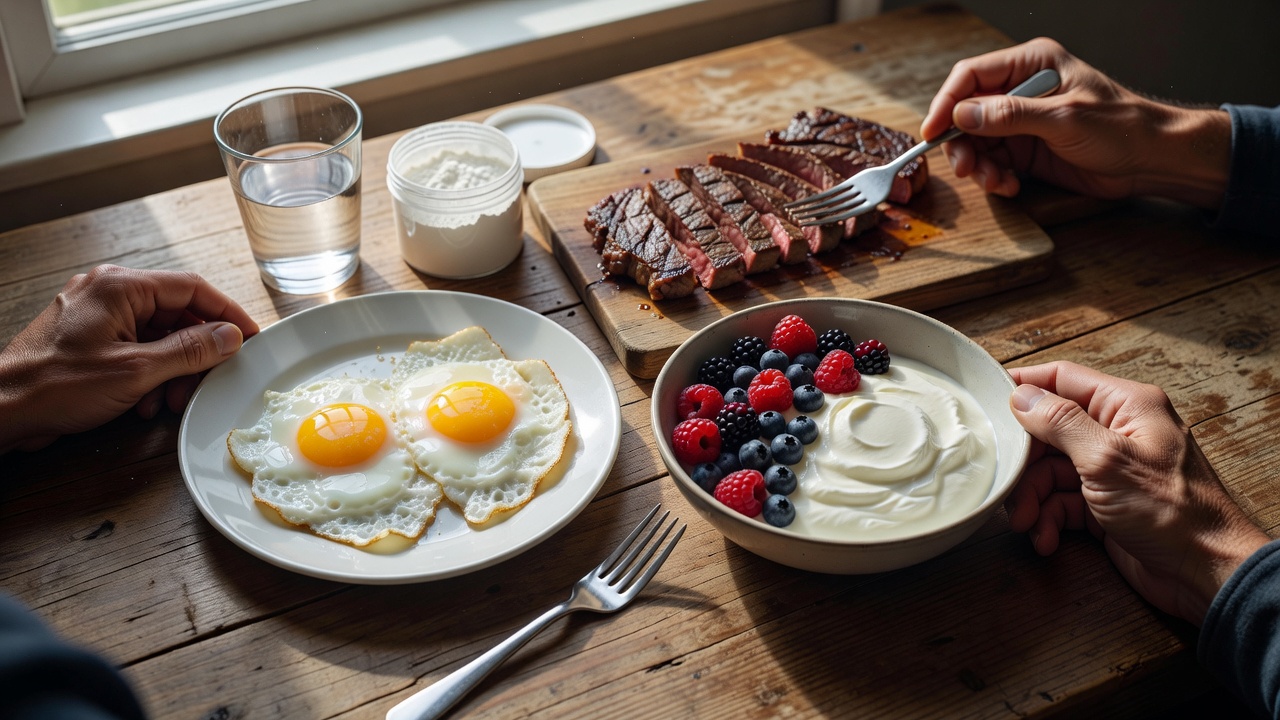
This week on X is not a new diet war. It is men over 40 arguing whether two eggs count as breakfast, whether a powder shake is a meal, and whether a seven-item “hormone stack” beats a boring plate of meat, potatoes, and vegetables. The default this article argues: put a real protein serving on the plate first, from food you can name, hit it three or four times a day, and stop building the week around leftovers, bars, and hope.
Not medical advice
This is a food default for generally healthy men, not a diagnosis, a clinic protocol, or a substitute for a doctor. If you have kidney disease, a prescribed diet, or unexplained weight change, get that checked before you change how you eat.
What X is actually arguing
Three camps are loud, and they are not the same plan with different branding.
The first camp is the repeatable plate. Coaches posting for dads and men over 40 keep saying the same sentence: protein first, every meal, 40 to 50 grams on the plate, most days, from eggs, yogurt, chicken, beef, fish, cottage cheese. The day is a template, not a mood. Breakfast is yogurt and whey or eggs. Lunch is chicken, rice, broccoli. Dinner is beef or salmon and a potato. If you are short at night, cottage cheese. Eat that most days and the week takes care of itself.[1]
The second camp is the aesthetic stack. The post that actually moved this week was a 30-day “eat like this” list: eggs and avocado at breakfast, grass-fed beef with sweet potato and spinach at lunch, brazil nuts and dark chocolate as a snack, salmon and broccoli at dinner, pumpkin seeds and kefir before bed, a ginger shot in the morning. It reads like a supplement aisle in food form. Men bookmark it because it sounds like a hormone protocol. It is still just food, with extra shopping.[2]
The third camp is the number. You will see 0.7 g per pound as a floor, 0.8 to 1.0 g per pound as the working range, and “your bodyweight in pounds, that many grams a day” as the blunt version — 200 lb, 200 g, or round down to 0.8 if that feels like a second job. Clinical-sounding posts sit lower, around 1.0 to 1.6 g per kilogram, with 25 to 40 g per meal. Same fight, different units. The tension is not vegan versus meat. It is whether you treat protein as a target you hit on purpose or as a side that showed up with dinner.[3]
A quieter fight sits under that: whole food versus powder. One side wants Class A protein — meat, eggs, dairy, seafood — and treats tubs as advertising. The other side will take whey in Greek yogurt at 6 a.m. because the alternative is coffee and a pastry. After 40, both can be true. Food first. Powder as a gap-filler. Not the other way around.[4]
What is actually loud is the heuristic, not the macro spreadsheet. “Protein first” means you decide the protein serving before you decide the carb, the sauce, or the restaurant. “Whole foods” means the ingredient list is short enough to say out loud. The men arguing in the replies are not splitting leucine milligrams. They are trying not to get softer on leftovers and takeaway.
Why this lands after 40
Muscle does not leave in a dramatic week. It leaks. You eat like you did at 28 — toast, a sandwich, a big dinner, drinks — while recovery, sleep, and training volume all get worse. The scale may not move. The waist does. Strength work without enough protein is expensive cardio.
The mechanism that keeps showing up in this week’s posts is the per-meal dose, not the daily average. Two or three eggs are roughly 12 to 14 g of protein. That is a garnish. After 40, the meal that does not clear a useful amino-acid threshold is just calories with a protein story attached. Five or six eggs, or eggs plus yogurt, or a proper piece of meat, is a meal. Two eggs and hope is breakfast theater.[5]
Protein and fiber together are doing the unglamorous work: slower eating, fewer 9 p.m. raids, steadier energy. The plate that starts with meat or yogurt and then adds vegetables, beans, fruit, or oats beats the plate that starts with bread and negotiates protein later. That is not a personality trait. It is order of operations.[6]
Breakfast is where the week dies. Men skip it, drink coffee, graze, then eat a heroic dinner and call it “high protein.” The first solid 40 g is the lever that makes lunch easier and the afternoon less stupid. You do not need a ginger shot to get that effect. You need food in the bowl before the inbox wins.[7]
Age is the excuse in the park. The actual pattern is years of comfortable food, missed lifting, and protein that never got counted. Forty did not do that. The grocery cart did.[8]
The default, in enough detail to actually do it
Weigh yourself once. Take bodyweight in pounds times 0.8. That is the daily protein number you actually try to hit. A 190 lb man is looking at about 150 g. A 220 lb man is looking at about 175 g. If you lift three days a week and recover, you can push toward 1.0 g per pound. If 200 g turns the kitchen into a part-time job, stay at 0.8 and do not miss days. Hitting 0.8 most days beats a perfect 1.0 you run for nine days.
Split it so each eating occasion is 35 to 50 g, not 15 g sprinkled across snacks. Three meals at ~45 g, or three meals plus one dairy hit at night. Do not save the protein for 8 p.m.
Protein first, every time you sit down. Put the meat, fish, eggs, or yogurt on the plate or in the bowl first. Then vegetables. Then a starch if you need the energy — rice, potato, oats, fruit. Fat comes with the food or as olive oil. You do not build the meal around the bun and then hunt for chicken.
Use a short list. You do not need twenty proteins. You need eight you will actually buy:
- Eggs
- Plain Greek yogurt (nonfat or 2%)
- Cottage cheese
- Chicken thighs or breast
- Lean ground beef or a steak you will cook
- Salmon, tuna, or sardines (fresh or canned)
- Whey, unflavored or simple, as a gap-filler
- Optional: turkey, shrimp, extra egg whites if the yolk volume gets annoying
Carbs and plants that do not fight you: potatoes, rice, frozen broccoli, green beans, spinach, berries, bananas, oats, beans if your gut tolerates them, olive oil. That is a grocery list, not a lifestyle.
A day that hits ~160 g without a spreadsheet:
Breakfast, within an hour of waking. 4 whole eggs scrambled (24–28 g) plus 200 g plain Greek yogurt (about 20 g) and a cup of berries. Coffee after the food, not instead of it. If you refuse to cook in the morning: 350 g Greek yogurt, 1 scoop whey, berries, a spoon of chia. That is 40–50 g in two minutes.[9]
Lunch. 200 g cooked chicken thighs or a large breast, 1 cup cooked rice, a pile of broccoli. Salt it. You are in the 45–55 g range depending on the cut. Leftover steak from dinner works the same.
Dinner. 220 g lean beef or a salmon fillet, potatoes, green beans or a salad with olive oil. Another 40–50 g. If dinner is a restaurant, order the protein first — fish, steak, chicken — then the vegetable. Skip the bottomless bread. You already know how that ends.
If you are short. Cottage cheese, 300 g, is a late hit. Canned sardines on leftover rice is a late hit. A whey shake on top of food is a late hit. A whey shake instead of food, most days, is how the diet becomes a tub.
Cook twice. Sunday and Wednesday. Tray of thighs, tray of beef or salmon, pot of rice or a bag of potatoes, two bags of frozen vegetables. Breakfast is eggs or yogurt. You are not meal-prepping for Instagram. You are removing the 6 p.m. decision.
Eating out and travel: the rule does not change. Ask what the protein is. Eat that. Add vegetables. Starch if you trained. Airport: Greek yogurt, jerky, canned fish, a boring grilled chicken plate. Do not let “no time” mean pastry plus a protein bar and a story.
Whey belongs in the gap, not the identity. Mix it into yogurt. Use it post-training if lunch is late. Do not let a 25 g scoop be the only protein you can point to before 3 p.m.
Fiber is the other half of “protein first, whole foods.” After the protein is on the plate, add the vegetables, beans, fruit, or oats. Protein without plants is a possible short phase. It is a poor default for a 45-year-old gut, a 45-year-old blood pressure, and a 45-year-old bathroom.
Alcohol is not a protein source and it displaces the meal that was supposed to be. If you drink, it goes after the plate, not instead of it, and not every night. That is a nutrition problem before it is a morality problem.
Track for 14 days if you have been winging it. You do not need to track forever. You need one honest look at whether “I eat pretty high protein” is 90 g or 160 g. After that, the plate rule is enough for most men.[10]
What people get wrong
Calling two or three eggs a high-protein breakfast. It is not. Pair them with yogurt, extra whites, leftover meat, or a scoop in the bowl. Or cook more eggs. Do not narrate 14 grams as a protocol.
Building the week on bars, shakes, and “high-protein” packaged snacks. Convenience is fine as a patch. A diet of wrappers is still ultra-processed food with a fitness label. Whole food first. Powder second. Bar last.
Saving protein for dinner. The 40 g first meal is the one that changes the afternoon. Dinner-loading is how you get a steak at 8 p.m. and cravings at 10 a.m.
Copying the seven-item hormone stack and then quitting on day six because brazil nuts, kefir, ginger shots, and pomegranate do not survive a real calendar. Pick four meals you can repeat. Micronutrients come from meat, eggs, dairy, fish, and plants you actually eat, not from a screenshot.
Treating whey as either magic or poison. It is powdered milk protein. Useful when food is late. Not a hair protocol, not a personality, not a replacement for chewing. Food still has to show up.
Blaming 40 while the cart is bread, takeaway, and liquid calories. The men at the park who say “the body just isn’t the same” are often describing a decade of low protein and no lifting. Get the plate right before you mythologize the birthday.
This week
- Write one number on a note on the fridge: bodyweight in pounds × 0.8. That is the protein target for the next seven days.
- Build tomorrow’s first meal tonight so it hits 40 g without a negotiation — eggs plus yogurt, or yogurt plus whey plus berries.
- Buy protein before you buy anything else: a tray of chicken or beef, a dozen-plus eggs, two tubs of plain Greek yogurt, frozen vegetables, potatoes or rice.
- Eat the same lunch three times: chicken, rice, broccoli, salted. Do not improvise weekday lunch.
- For 14 days, or at least these 7, log protein only. Ignore the rest of the macros unless the waist is clearly moving the wrong way.
- If you lift, put a protein meal within a couple of hours of the session. If you do not lift, start walking after two of the meals. Food first still needs a reason to keep the muscle.
Read next
Back to Trending on X.