Protein per sitting
Updated October 1, 2026. Trending in Nutrition on X.
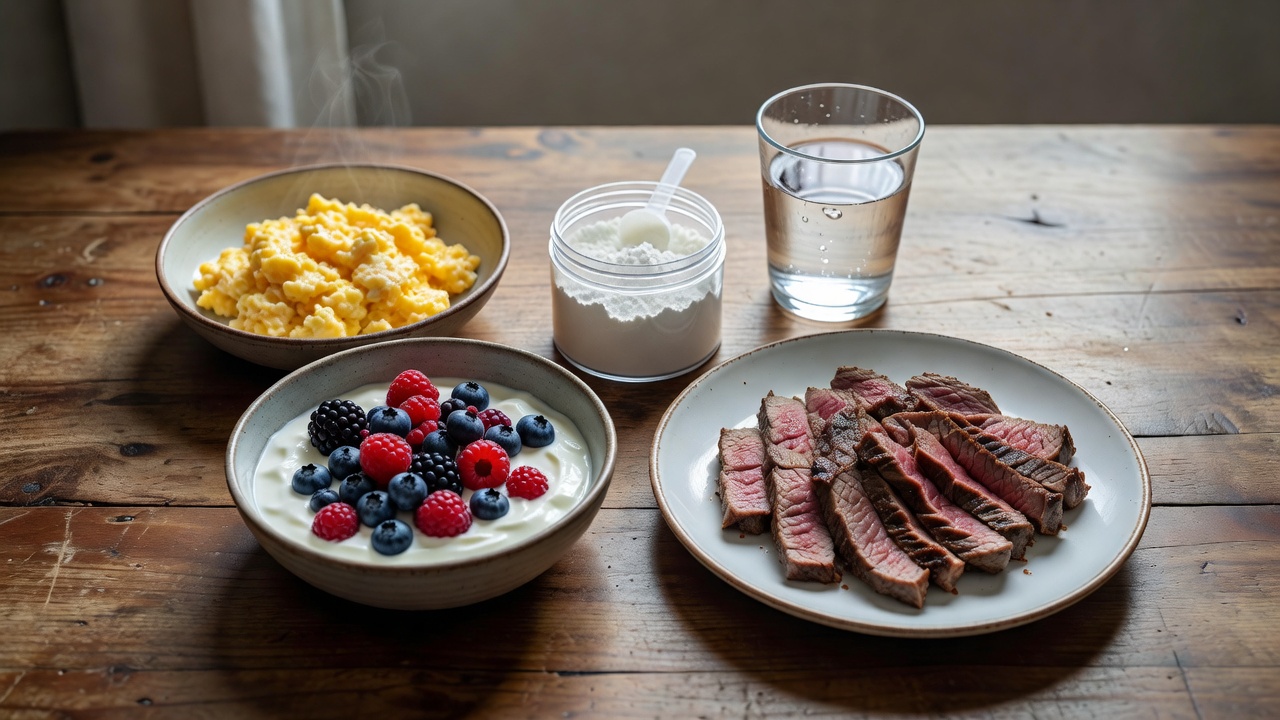
September on X was the same fight on repeat: a 20–30 g “absorption ceiling” versus coaches telling men past 40 to put 35–50 g on the plate every time they sit down. This page takes the second camp, with a limit. Hit 35–45 g of actual protein per sitting, three or four times a day, breakfast included. Daily total still counts. Per-meal dose is how you stop wasting the days you already “ate enough.”
Not medical advice
This is a food default for healthy men over 40, not a treatment plan. Kidney disease, prescribed diets, and anything a clinician already set for you sit outside this page.
What X is actually arguing
Three camps showed up, and they are not answering the same question.
Camp one still repeats the old gym rule: the body can only “use” 20 or 30 grams at once and the rest turns to fat. That line travels because it is simple. It is also the claim getting dunked. A 58-year-old poster put the counter on the table: 100 g of protein in one meal produces a bigger, longer anabolic response — more than 12 hours — and amino acids go to enzymes, connective tissue, and immune proteins, not just muscle. Extra protein in a sitting is not a fat spell.[1]
Camp two is the aging-athlete default, and it dominated 40+ nutrition threads this month. Anabolic resistance means the dose that built muscle at 25 barely registers at 50. Practical numbers clustering on X: 30–40 g per meal past 40, about 40 g after 50, some coaches pushing 40–50 g across four meals. Spread it. Do not back-load dinner. Give the muscle repeated chances to switch synthesis on.[2]
Camp three is quieter and more honest about hypertrophy: if daily protein is already high (~1.6 g/kg), four 30 g meals versus two big boluses does not magically change how much muscle you keep. A 25–40 g sitting across 3–4 meals can raise 24-hour muscle protein synthesis a bit. The real-world size difference stays small when the day is already loaded. After 40, that nuance does not save a toast breakfast. It just stops you from panicking over a 55 g steak.[3]
The complaint that actually got views is the pattern, not the textbook. Most men eat the smallest protein meal at breakfast and the biggest at dinner. That is backwards. Muscle protein synthesis needs roughly 30–40 g to trigger, and the hole is 7 a.m. A protein-heavy dinner with a carbohydrate breakfast is the worst common pattern for keeping muscle, and it is the one most adults still run.[4]
Daily targets on the same threads ran from the RDA (0.8 g/kg — treated as a joke by anyone who lifts) through European sarcopenia ranges (1.0–1.2 g/kg for healthy older adults, up to 1.5 g/kg if ill) to the coach default of 0.7–1.0 g per pound for active men. A 200 lb man on that last range is 140–200 g a day. Distribution is how you get there without one grotesque dinner.[5]
Why this lands after 40
You are not 25. Same grams, weaker signal.
Anabolic resistance is the name. Older muscle builds about 40% less new protein from the same feeding. A model that circulated this month did not find one broken switch. It found six small failures stacking: gut and liver extract more amino acids before they reach muscle, delivery drops, insulin is worse at turning growth on, there is less mTOR, mTOR answers leucine more weakly, and the downstream translator protein is down. Fix one in a simulation and nothing much happens. All six together match the 40% deficit. That is why “just eat a bit more” and “just take leucine” keep disappointing people who still skip breakfast.[6]
What you can still control without a lab: the size of the leucine hit and how many times you send it. Mixed meals in older men often need a bigger protein bolus to reach the leucine threshold young men hit at ~20 g of whey. That is why 25–30 g is the young-adult number and 30–40 g — sometimes 40+ — is the over-40 number. Half that, and the signal never really fires.[7]
Two more constraints. First, a lot of men in this age band still land at 60–70 g a day. For a 70 kg man, sarcopenia-style guidance is already ~84 g, and a lifting 90 kg man needs more like 140+. Second, the habitual pattern — carb breakfast, protein dinner — gives you one synthesis pulse when you could have had three. The muscle you lose from 40 to 60 is not a cliff. It is skipped breakfasts, year after year.
Resistance training is the other half. Protein without loading the muscle is expensive urine with extra steps. This default assumes you put a barbell, dumbbells, or a hard machine session on the calendar a few days a week. If you do not lift, start there. Do not wait to fix the plate.
The default, in enough detail to actually do it
Per sitting: 35–45 g of protein. Floor: 30 g if the food is leucine-dense (eggs, dairy, whey, meat, fish). A 20 g “protein meal” after 40 is a side, not a sitting.
Sittings: 3 or 4. Four is easier if lunch is a desk meal. Three works if each plate is closer to 45–50 g.
Daily, if you lift: 0.7–1.0 g per pound of the bodyweight you actually want to carry. 180 lb man: 125–180 g. 200 lb man: 140–200 g. If you are 240 lb and cutting toward 200, aim protein at the target weight, then keep it high while calories drop. The sedentary floor is not 56 g a day. Use ~1.2 g/kg as the “I exist” line, then go up when training starts.
Breakfast is non-negotiable. That is the sitting most men skip. Build it the night before if mornings are chaos.
Concrete ~40 g sittings (weigh twice, then you will know):
- 4 large eggs (~24 g) + 200 g 2% Greek yogurt (~20 g)
- 3 eggs + 1 scoop whey in water or milk (~18 + 25)
- 170 g cooked chicken breast (~50 g) — trim if you only need 40
- 200 g 93% beef (~45 g) or 180 g salmon (~40 g)
- 300 g low-fat cottage cheese (~36–40 g), or 200 g cottage plus a scoop
- 150 g firm tofu is not 40 g. If you eat plant-heavy, stack it: larger tofu plus dairy, seitan, or a whey/casein shake. Do not log “stir-fry with some chicken” as 40 g.
A day that hits the default for a ~180 lb lifter:
- 07:00 — 4 eggs, Greek yogurt, fruit. ~44 g
- 12:30 — chicken, rice or potatoes, vegetables. ~45 g
- 16:30 (training day) — whey in water. ~25 g. This is a top-up. Add milk or skyr if you need it to 35.
- 19:00 — steak or fish, vegetables, potatoes. ~45 g
Skip the 16:30 shake and make lunch and dinner ~50 g each if you only want three sittings. Do not “save it for dinner.”
If you only eat twice a day: the 20–30 g ceiling is still false. Two sittings of 50–70 g beat four sittings of 15 g. A large meal still feeds a long amino-acid curve. You just miss pulses. Three sittings is the default because adherence is easier than OMAD heroics and you get more chances to clear the leucine bar.
Restaurant and work rules, because that is where the sitting dies:
- Breakfast out: two eggs are ~12 g. Add a yogurt, smoked salmon, extra egg whites, or a side of turkey. Toast is not the protein.
- Lunch out: order the chicken or fish as the center, then add a second protein if the fillet is small. A Caesar with “some chicken” is usually 20–25 g.
- Office: whey and a tub of Greek yogurt in the fridge beat a plan that requires cooking at 6:30 a.m.
- Low morning appetite: liquid first (whey + milk), then eggs. Do not wait to be hungry for 40 g of steak at dawn.
- Travel: two Greek yogurts plus a jerky pack, or a shake plus whatever eggs the hotel will actually cook.
Quality: animal proteins hit the leucine number in less food. Whey is a lever, not a personality. Whole food first if it fits the day; a shake is how you stop failing breakfast on workdays. Track grams for 7 days. Most men over 40 who “eat a lot of protein” are at 90 g with one real sitting. The gap is almost always breakfast and the sandwich.
What people get wrong
-
Treating 20–30 g as a hard cap, then stopping the plate. Extra protein in a big meal is not stored as fat by magic. It is oxidized, used for non-muscle proteins, or extends the anabolic window.
-
Eating 15 g at breakfast, 20 g at lunch, 70 g at 9 p.m., then arguing daily total. After 40 that pattern is the worst one in the threads: one pulse, two missed triggers, a heavy evening load on sleep.
-
Using the RDA (0.8 g/kg) as a goal. That number was built on young adults and nitrogen-balance methods. It is a deficiency line, not a muscle line.
-
Calling a meal “high protein” because it contains chicken. 80 g of chicken breast is not 80 g of protein. Weigh it once.
-
Matching plant portions to meat portions. 30 g of mixed plant protein is a weaker leucine hit than 30 g of whey or eggs. If you eat that way, the sitting needs to be larger or topped up.
-
Chasing 50 g four times a day on a 160 lb frame, getting stuffed, then quitting. Hit 35 g three times first. A 200 g day you run for four days is not a default.
This month
-
Weigh protein foods for seven days. Write the grams per sitting, not only the daily total. Circle every sitting under 30 g.
-
Fix breakfast before you fix anything else. Eggs plus yogurt, or eggs plus a scoop. No cereal-only. No toast-only.
-
Set a per-sitting floor: 35 g, on three plates. If a plate cannot hit 35, add 150 g of Greek yogurt, cottage cheese, or a scoop. Do not “try harder tomorrow.”
-
Lift at least twice this week on compound patterns (squat or hinge, push, pull). Protein without tension is a weaker default.
-
If dinners are already 50–60 g, steal from dinner and move 20 g to lunch. Do not add a fourth dessert.
-
Re-check at day 30: four weeks of 3×35 g minimum. If bodyweight is drifting up and you are not trying to gain, cut starch at the non-training meals, not the protein.
Read next
Back to Trending on X.