Deep sleep drop
Archived — September 20, 2026
Snapshot of Trending on X that day. Current · All snapshots
Updated September 20, 2026. Trending in Health on X.
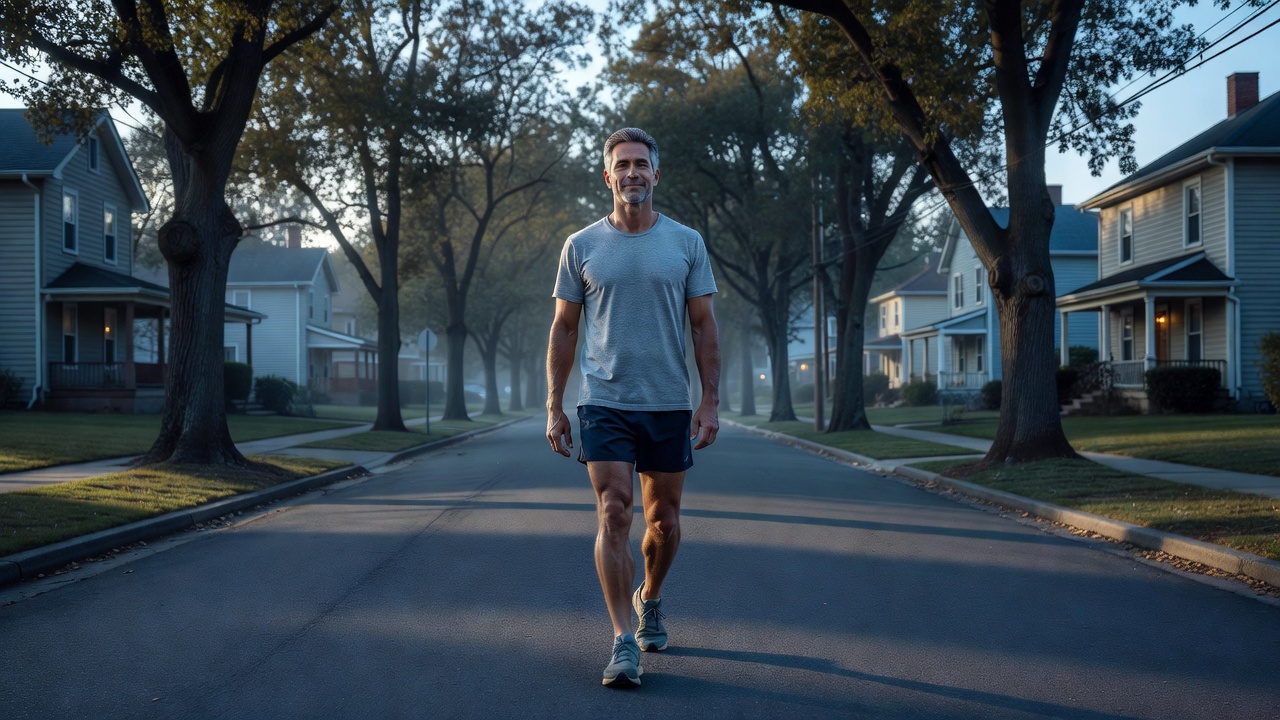
X this week is split on the same complaint: you still get seven hours, you still wake unrested, and someone in the replies is either calling it “just aging” or selling a peptide. The loud fact is the deep-sleep drop after 40 — slow-wave sleep shrinking while clock time holds — and the default this article argues is boring: a fixed sleep window, morning light, real training load, and no evening alcohol so the first half of the night actually does maintenance.
Not medical advice
This is a habits default for men over 40, not a diagnosis or a clinic protocol. Unrefreshing sleep plus snoring, gasping, or collapsing daytime energy belongs with a doctor and a proper evaluation, not a thread.
What X is actually arguing
The post that actually moved this week said it in numbers: after 40 you lose about 30 minutes of deep sleep per decade. A young adult spends roughly 20 percent of the night in slow-wave sleep; by 50 that is closer to 15 percent; later some men get almost none. Total hours often look the same. You assume stress. The mechanism named on X is more specific — the brain generating fewer of the slow electrical waves that define the deepest stage. That is when tissue repair, memory consolidation, and glymphatic waste clearance (including amyloid) are supposed to run. Less depth, less flush.[1]
One camp treats that as fate. Another camp — the men’s accounts stacking “prioritise deep sleep” as item 3 or 4 — treats hours in bed as the wrong scoreboard. Poor sleep accelerates aging faster than most of the other levers they list. The bed is framed as a maintenance shift, not a place you happen to pass out. Alcohol is the other loud fight: the guy who “only drinks a little to shut the brain off” gets told he is sedated, not repaired. It knocks you out, then wrecks the second half of the night, leaves you foggy, hungrier, and less insulin-sensitive, then you caffeine through the morning. For a lot of midlife men it is not the Friday blowout. It is two or three drinks most nights on already short sleep.[2]
A third camp is the apnea and training crowd. Untreated sleep apnea shows up in lists next to morning wood, testosterone, and vascular problems. Consecutive short nights do not just make you tired; they make training deceptive — same weights, higher RPE, missed reps, lingering soreness, fog in meetings. Hard lower-body work over weeks has been tied to better sleep efficiency in older adults; the midlife version of that argument is lift 2–3 real sessions and stop treating five hours plus coffee as a personality. A thinner, louder minority is talking DSIP and other peptides because sleep “tanked at 42.” That is noise relative to the architecture problem. Foundation first.
The tension is hours versus depth, sedation versus slow-wave, and biohack versus a calendar you actually keep.
Why this lands after 40
Slow-wave sleep is front-loaded. Most of it happens in the first third of the night. Go to bed late, drink, or fragment the night with apnea and you do not get a second chance at the same volume of N3. After 40 the generator itself is weaker. Circadian amplitude is flatter. Visceral fat and neck circumference raise apnea odds. Evening cortisol stays higher if the day was unmanaged. Testosterone production and the growth-hormone pulse that ride overnight sleep get a smaller window. You do not bounce back from one short night the way you did at 28.
The downstream is not mystical. Less deep sleep means worse next-day insulin handling, louder hunger, flatter training quality, and a brain that did not clear waste. Whitehall-style data keeps getting quoted for a reason: under six hours at 50 is not a badge; it is associated with a large jump in later dementia risk, and the mechanism people keep repeating is that waste clearance happens in deep sleep and nowhere else. You can still “function.” You are not recovering. Sleep debt spillover is why the same program that worked at 35 stalls at 45 even when you still show up.[3]
Alcohol hits this age group harder because it is the socially acceptable wind-down and because you already have less SWS to spare. Screens and a 10:47 doomscroll delay melatonin and steal the early-night window. Skipping the lift because you “slept badly” then sleeping worse because you did not load the system is the loop.
The default, in enough detail to actually do it
Protect the first four hours. That is the job.
Pick one window and run it seven days. Example that fits most work weeks: in bed 10:30 p.m., lights out, alarm 6:30 a.m. That is eight hours in bed to net something like 7–7.5 of sleep. Do not negotiate Friday and Saturday by two hours; the circadian system after 40 does not reset on a weekend like a college kid’s. If your job forces 5:30 a.m., shift the whole block earlier. The rule is same clock, not same “I got enough.”
Morning light is not optional. Outside, 10–20 minutes, within an hour of waking, even if it is overcast. Walk it if you can. That sets the cortisol peak earlier so it is not still hanging around at 10 p.m. Indoor lamps do not count.
Training is the most reliable SWS bump X keeps citing. Two or three lifting sessions per week: squat or hinge, push, pull, some loaded carry. Hard enough that you would not want to do another set. Not a 9:30 p.m. PR attempt. Add 30–45 minutes of moderate aerobic work or a brisk walk most days — the 30-minute moderate session is the one repeatedly tied to more slow-wave that night. If you only have 25 minutes, walk after dinner, not a HIIT class at 8 p.m. that leaves you wired.[4]
Alcohol: zero Sunday through Thursday. If you drink socially, last drink at least four hours before bed, two drinks max, not three. The “I need it to sleep” pattern is the one wrecking architecture. You will sleep worse for a few nights when you cut it. That is withdrawal plus a circadian system that was using ethanol as a blunt instrument. Push through the week.
Caffeine cutoff eight hours before the pillow. If bed is 10:30, last coffee is 2:30 p.m. Tea at 4 p.m. is still a tax for a lot of men this age.
Bedroom: cool (around 65°F / 18°C is the range people actually keep), dark, phone charged in another room. Wind-down is 30–45 minutes of dim light, not a series finale. If you need a buffer, paper book or nothing.
Dinner: protein you can count — 40–50 g from meat, fish, eggs, or dairy — plus some carbohydrate if it helps you stay asleep. Finish eating two to three hours before bed. Late grazing is not “fueling recovery.” Magnesium from food first (pumpkin seeds, spinach, beans, some dark chocolate). Some men add magnesium glycinate in the evening because it is the form that shows up in this week’s recovery posts; treat it as a gap-filler, not the plan.[5]
If you snore, your partner says you stop breathing, you wake with a dry mouth or a headache, or you are exhausted after a “full night,” that is not a deep-sleep-drop article problem. Get evaluated. Do not self-prescribe a machine from a thread.
Crude scoreboard for seven days: how you feel at 10 a.m., whether morning wood is present more days than not, whether the same weights feel like the same weights. Wearable deep-sleep minutes are noisy; use them as a trend, not a religion. Depth and regularity beat a heroic 9-hour lie-in after four short nights.[6]
What people get wrong
Counting hours while drunk or fragmented. Eight hours of alcohol sleep is not seven hours of slow-wave.
Using two drinks as a sleep aid and calling it “not much.” That is the midlife pattern, not the binge.
Treating a 5 a.m. alarm on six hours as discipline. The brain does not clear the debt on pride.
Chasing DSIP or the latest peptide because sleep tanked at 42 before you have a fixed bedtime, daylight, and a snoring check.
Training through stacked short nights, then blaming the program when RPE climbs and reps disappear.
Phone on the nightstand. Late news. “I’ll just check one thing.”
Assuming low energy is only testosterone and skipping the night that actually produces it.
This week
- Write the sleep window on paper — same lights-out and same wake, all seven days — and keep it.
- Zero alcohol Sunday through Thursday. Note 10 a.m. clarity each day.
- Outdoor light 15 minutes every morning, walk if you can.
- One extra 30-minute moderate walk or easy cardio, not after 7 p.m.
- Phone charger leaves the bedroom tonight.
- If you snore or wake unrefreshed, book the conversation about a sleep evaluation. Do not wait for a “bad month.”
Read next
Back to Trending on X.