25–30 g per meal
Archived — September 20, 2026
Snapshot of Trending on X that day. Current · All snapshots
Updated September 20, 2026. Trending in Nutrition on X.
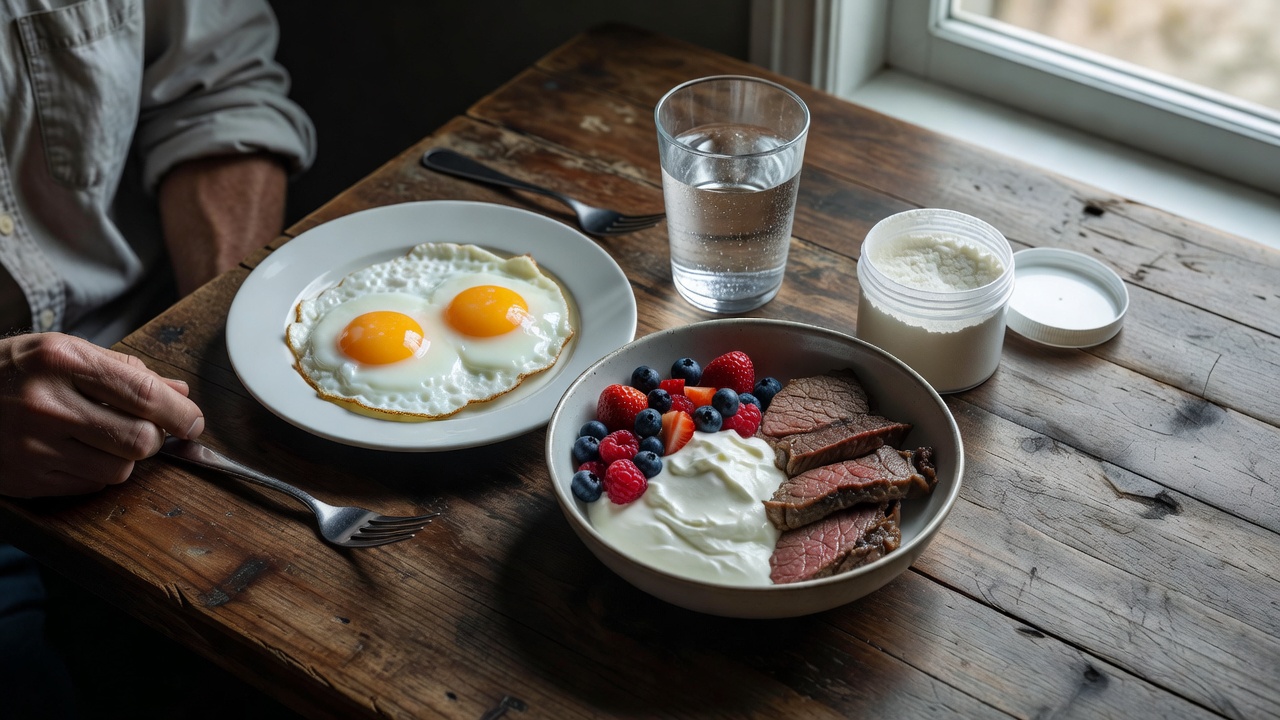
X spent the week treating protein as a per-meal problem, not a daily spreadsheet. The same 15–20 g breakfast that “worked” at 25 is being called a non-event after 40. The fight is whether 25–30 g is the floor that turns muscle protein synthesis on, or whether anabolic resistance now demands 40 g. This article takes the floor: 25–30 g at breakfast, lunch, and dinner, from food you already buy. Raise it if you train hard. Do not wait for a perfect 160 g day.
Not medical advice
This is a default for generally healthy men, not a treatment plan. Kidney disease, unexplained weight loss, or a clinician already managing your diet are reasons to get a real opinion before you change intake.
What X is actually arguing
The loudest nutrition post of the week was a simple claim: the meal that built muscle at 25 barely registers at 50. Anabolic resistance means older muscle needs a larger protein dose to get the same synthesis response, and most people over 40 are eating less protein than they need, not more. The European sarcopenia range cited in that thread was 1.0–1.2 g per kilogram for healthy older adults, versus the 0.8 g/kg RDA built on young adults. For a 70 kg man that is about 84 g a day. Most adults over 50 were described as landing at 60–70 g, with the worst pattern being a carb breakfast and a protein-heavy dinner. Distribution was the point: 25–30 g per meal beats the same grams dumped into one plate.[1]
A second camp, mostly coaches writing to men 40+, moved the number up. Cheat sheets this week listed breakfast at 25–40 g, lunch and dinner at 30–40 g, and a snack at 20–30 g. Clinic-adjacent posts said 15 g at breakfast does not clear the leucine threshold and pushed 30–40 g per meal. One trainer put it bluntly: at 25, 20 g triggers growth; at 45+, that same 20 g barely registers, so the dose has to move toward 40 g. That is the tension inside the title. 25–30 g is the floor that showed up in the viral thread. 30–40 g is what a lot of the 40+ accounts are actually running.[2]
A third camp is still fighting the old gym line that the body can only use 20–30 g at a time. One post this week pointed at men eating 100 g of protein after lifting and getting a larger, longer anabolic response, not wasted amino acids. That camp cares about daily total and the training stimulus more than meal math. It does not rescue a 10 g breakfast. It just means a big dinner is not “thrown away.”[3]
Underneath the grams, source quality got loud. Olympic-medalist coaching content listed lean beef, salmon, eggs, Greek yogurt, cottage cheese, tuna, shrimp, and chicken as the foundation, with bars and nuggets allowed but not doing the heavy lifting. Separate posts kept repeating that two eggs are not a high-protein breakfast: 12–14 g. Shakes were defended only as a gap closer when the real meal fails. Almost nobody serious was defending toast-and-coffee as “fine because dinner is big.” Breakfast and lunch are where the week’s argument actually lives.[4]
Why this lands after 40
Anabolic resistance is not a slogan. Muscle becomes less sensitive to the same amino-acid pulse. You still eat the food. You need more leucine in one sitting to switch synthesis on. In mixed meals that works out around 25–40 g of high-quality protein, not 15 g of eggs on toast. Past 40 that gap shows up as slow muscle loss even when the scale is stable, because the scale does not tell you what left.[5]
The RDA was never a hypertrophy or anti-sarcopenia target. It was a young-adult nitrogen-balance number. Appetite drops, chewing gets lazier, breakfast gets skipped for coffee, and lunch becomes a sandwich. Three windows in a row never cross the threshold. A 40 g steak at 8 p.m. does not retroactively turn 7 a.m. into a muscle meal.
That is why per-meal math is not bodybuilding theater after 40. Daily totals still matter if you lift and you are in a deficit. They do not excuse three sub-threshold meals. Training still amplifies the response. Protein without a load is a weaker signal. This page is the fork. The bar still has to move.
The default, in enough detail to actually do it
Default: 25–30 g of protein at breakfast, lunch, and dinner. That is the job. Dietitians this week said the same thing in plainer language: if 140 g a day feels impossible, stop chasing 140 g. Get breakfast from 10 g to 25–30 g, lunch from 15 g to 30 g, and dinner in the same band. The daily total rises because the meals stopped being empty.[6]
For a man around 80–90 kg who lifts, a working daily range many accounts used this week is 1.6–2.2 g/kg if the goal is holding muscle in a cut. You do not need that on Monday. Three meals at 30 g is 90 g. That already beats the 60–70 g pattern. If you already train and 30 g is easy, live at 30–40 g per meal. Do not start at 40 g, fail breakfast, and quit.
Put the protein on the plate first. Then add plants and starch.
Breakfast that actually hits 25–30 g: - 3 large eggs (~18 g) plus 170 g plain 2% Greek yogurt (~17 g) - 250 g cottage cheese (~28 g) - 2 eggs, 50 g smoked salmon, 30 g cheese - leftover 120–150 g chicken with eggs - 40 g whey in 300 ml milk if you are in a hotel (~30–35 g)
Two eggs alone are half a meal. Do not call them breakfast.
Lunch: - 120–150 g cooked chicken breast - one can tuna plus 100 g Greek yogurt or two extra eggs - 150 g 93% lean beef - if you eat plant-heavy, do not pretend 8–12 g of dal is the protein. Pair it with eggs, yogurt, paneer, or a larger soy portion and still count the leucine.
Dinner: - 150–180 g salmon, white fish, or steak - the same chicken you batch-cooked - 200 g cottage cheese plus a small piece of meat if night appetite is low
Restaurant rule that circulated this week: if it comes with grilled chicken, get double. A typical 4 oz plate is about 25 g. That is the floor, not a feast. About 130 extra calories buys you the second portion.[7]
Order at the table: protein, vegetables, then starch. Alcohol is not a reason the 25–30 g disappears. If you eat four times, extras are 20–25 g snacks (skyr, jerky, leftover meat). Do not replace three meals with grazing. One post this week said it as a rule: stop grazing, build every meal around protein first.[8]
Sample day, not a clinic protocol: - 07:30 — 3 eggs, 170 g Greek yogurt. ~35 g - 12:30 — 140 g chicken, vegetables, rice or potato. ~40 g - 19:00 — 160 g salmon or 150 g beef, vegetables. ~35–40 g - Optional — 200 g cottage cheese only if a meal collapsed
That is 110 g without a shake. Use whey when breakfast dies, not as the identity of the diet. Whole food first. A shake is not cheating if it closes a real gap. It is cheating if it is the only protein you respect.[9]
Grocery for one man, one week, bought first before snacks: - 2 dozen eggs - 2 kg chicken or a mix of chicken and fish - 1 kg plain Greek yogurt - 500 g cottage cheese - canned tuna, six cans - whey only if travel is real
Cook once. Bake a kilo of chicken on Sunday. Breakfast is the meal most men fail because it requires a decision at 6:40 a.m. Decide Saturday. Weigh protein for seven days so your eyes calibrate. After that, a notes app with three numbers is enough: breakfast, lunch, dinner.
What people get wrong
Two eggs as a “high-protein breakfast.” That is 12–14 g. After 40, that is not enough.[10]
Saving protein for dinner and calling the daily total fine. A protein-heavy dinner with a carb breakfast is the pattern most adults already follow, and it is the one the week’s threads called the worst for muscle.
Treating 20–30 g as a hard cap the body cannot use. The threshold to trigger synthesis is not a waste bin for everything above it. Large doses can still be used, especially around training. That does not make a 10 g breakfast adequate.
Letting bars, nuggets, and “high protein” snacks do the job of meat, eggs, dairy, and fish.
Chasing 160 g on an app while three meals still sit under 20 g. Fix the meals. The total follows.
Copying a 25-year-old’s breakfast and wondering why the scale is soft. The dose changed. The toast did not.
This week
- Write yesterday’s breakfast in grams. If it was under 25 g, that is the only problem you solve Monday.
- Pick one repeatable breakfast that hits 25–30 g. Eat it four mornings this week.
- At lunch, add 100 g of meat, fish, or Greek yogurt to the meal you already eat.
- Weigh the dinner protein portion once. Keep the rest of the plate.
- Do not add a fourth strategy. Three meals. Floor of 25–30 g.
- Lift twice if that is already your week. Protein without a load is a weaker default.
Read next
Back to Trending on X.