25-30 g per meal
Archived — September 24, 2026
Snapshot of Trending on X that day. Current · All snapshots
Updated September 24, 2026. Trending in Nutrition on X.
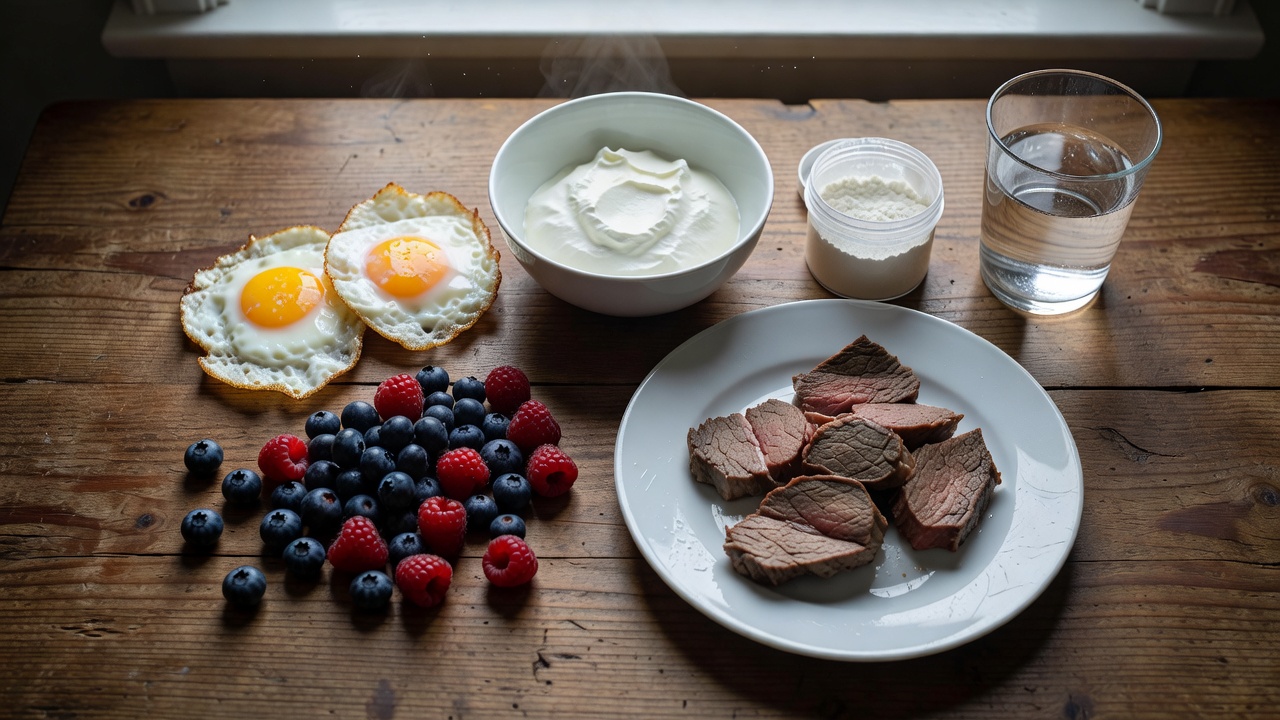
This week’s nutrition fight on X is not “eat more protein.” It is whether a meal even counts. One camp says 25–30 g is the dose that actually turns muscle protein synthesis on after 40. Another says bump it to 35–40 g because leucine sensitivity is worse than the 25-year-old papers assume. The default here is the floor most men over 40 still miss: 25–30 g at breakfast, lunch, and dinner. Hit that first. Then argue about 40.
Not medical advice
This is a food-distribution default for men who lift and want to keep muscle, not a treatment plan. If a clinician has already limited your protein, follow that.
What X is actually arguing
The post that actually moved this week was blunt: the same meal that built muscle at 25 barely registers at 50. Anabolic resistance means an older muscle needs a larger protein dose to get the same building signal, and most people over 40 are eating less protein than they need, not more. The European sarcopenia consensus cited in that thread sits at 1.0–1.2 g per kilogram per day for healthy older adults, and up to 1.5 g when someone is ill or recovering. The RDA of 0.8 g/kg was set on young adults. For a 70 kg man that consensus floor is about 84 g a day. Most adults over 50 land at 60–70 g. Distribution is the second punch: 25–30 g per meal beats dumping the same total into one dinner. A protein-heavy dinner with a carbohydrate breakfast is named as the worst pattern, and the pattern most adults still run.[1]
That is the 25–30 g camp, and it is the loudest. Replies and quote-posts this week keep repeating the same line: every meal is either building muscle or failing to, and the gap is about 20 g skipped at breakfast and lunch. Grok-style summaries of the same thread land on 1.0–1.2 g/kg daily with 25–30 g at each meal. Physician-adjacent accounts are repeating the distribution point, not inventing a new one: spreading 25–30 g across meals instead of loading dinner changes the trajectory. Breakfast-specific posts put a usable rule at ~30 g at meal one.[2]
The opposing camp is not “protein doesn’t matter.” It is “25–30 g is still a young-man dose.” Coaches working men over 45–50 say 20 g used to trip the switch and now it barely registers, so bump the meal to ~40 g. The leucine version of that argument is more specific: you need roughly 3 g of leucine in one sitting, which for mixed food protein looks like 35–40 g, not two eggs and turkey bacon at 19 g. On that view, a man can eat 130 g a day, hit the threshold only at dinner, and waste two or three building windows. Fix breakfast, they say, and you double the chances without necessarily raising the daily total.[3]
A third camp refuses to treat protein as the whole sport. For preserving muscle after 40, roughly 1.6 g/kg plus progressive resistance is the useful target — not just pushing protein higher. That camp will accept 25–30 g per meal as a distribution rule, then immediately ask whether you are actually loading a bar. Protein without the lift does not close the loop. The lift without the per-meal dose wastes the session. Both have to show up.[4]
The practical fight, then, is breakfast and lunch. Not another macro spreadsheet. Two eggs are being called out as a fake high-protein breakfast: 12–14 g. Eggs are fine. They are not enough. “Eat protein” is not the same instruction as “eat enough protein in one sitting.” That is the tension this page is resolving.[5]
Why this lands after 40
Muscle does not vanish because you got lazy in a moral sense. After 30 you lose on the order of 3–8% of muscle mass per decade, and the rate roughly doubles after 60. Grip goes first, then walking speed, then standing up from a chair without hands. By the time a 50-year-old notices the jar lid, the loss is already running. Sarcopenia consensus language now treats that as a condition to fight, not a personality trait. The tools named in that discourse are resistance training and adequate protein, together. Either one alone under-delivers.[6]
The mechanism X keeps naming is anabolic resistance. Younger muscle responds to a modest leucine pulse. Older muscle needs a bigger pulse to flip the same mTOR switch. That is why a 20 g hit that worked at 25 can do almost nothing at 45, and why grazing 8–12 g across the morning never adds up to a signal. Muscle protein synthesis is a per-meal event. Daily totals matter, but they do not rescue three sub-threshold meals. Accounts this week put the leucine number around 2.8–3 g in one sitting, which for mixed protein food is why 25–30 g is the cited floor and 35–40 g is the aggressive version.[7]
Digestion and use also get sloppier. The same grams on the label do not all show up as usable amino acids the way they did at 25. That is one reason the RDA looks adequate on paper and still leaves men in a slow deficit. In a calorie cut — the usual over-40 project after a decade of desk weight — a hard deficit without enough protein just donates muscle to the scale. Fat loss that costs 8 lb of muscle is a bad trade. The men posting 1 g per pound of goal bodyweight are trying to stop that trade, not win a bodybuilding show.
Insulin sensitivity, sleep, and alcohol all make the same grams less effective, but you do not need a hormone lecture to use the default. You need a meal that actually crosses the line, three times a day, while you still lift.
The default, in enough detail to actually do it
Floor: 25–30 g of protein at breakfast, lunch, and dinner. Treat 30 g as the number you aim at, 25 g as the miss you will tolerate once. Do not start at 40 g if breakfast is currently toast and coffee. Get three meals over 25–30 g for 14 days. Then, if you lift hard and recover well, push the bigger meals toward 35–40 g.
Daily total if you train: about 1.6 g per kilogram of body weight is the working target this week’s “protein plus the bar” camp is using. A 82 kg (180 lb) man is ~130 g. A 91 kg (200 lb) man is ~145 g. That is three 30 g meals plus a 30–40 g snack, or four meals in the 30–40 g band. The European 1.0–1.2 g/kg figure is a sarcopenia floor for older adults, not a lifting target. Do not confuse the two.
Breakfast is the lever. Build one of these and stop improvising:
- 3 whole eggs (~18 g) + 200 g low-fat cottage cheese (~24 g) = ~42 g. Overshoot is fine.
- 200 g 0% Greek yogurt (~18–20 g) + 1 scoop whey (~22–25 g) = ~40–45 g. Use this on rushed mornings.
- 4 egg whites + 2 whole eggs + 80 g leftover chicken = ~35–40 g.
- If you only have five minutes: 1.5 scoops whey in water or milk and eat real food at lunch. Do not skip the dose because the kitchen is messy.
Two eggs and a slice of bacon is ~19 g. That meal does not count. Add the cottage, the yogurt, the extra eggs, or the scoop. Then it counts.
Lunch and dinner are simpler because they already look like “a plate.” Weigh cooked meat once for two weeks until your eye is calibrated:
- ~120–150 g cooked chicken breast is ~36–46 g.
- A 5 oz (140 g) can of tuna is ~30–32 g. Eat the can, not two forkfuls on a salad.
- 170 g cooked salmon or 6–7 oz steak will clear 30 g without a shake.
- 250 g 2% cottage cheese is a full meal’s protein if the rest of the plate is light.
A repeatable day for an 180 lb man who lifts three days a week:
- 07:00 — 3 eggs, 200 g cottage, fruit. ~40 g.
- 12:30 — 150 g cooked chicken, rice or potatoes, vegetables. ~45 g.
- 18:30 — 170 g salmon or 6 oz 90% beef, vegetables, whatever starch your training day needs. ~35–40 g.
- Optional 21:00 if the day went sideways — 200 g Greek yogurt or one whey scoop. ~20–25 g.
That is 120–150 g without living in a blender. If lunch was a client meal and you got 15 g, do not “make it up” with a 70 g steak at 21:30. Add 25 g whey in the afternoon and keep dinner normal. Spacing of 3–5 hours is enough. You do not need eight feedings. You need three that clear the line.
Food first. Whey is a closer, not the diet. Lean beef, salmon, eggs, Greek yogurt, cottage cheese, tuna, shrimp, chicken should do the heavy lifting. Bars, nuggets, and deli meat can fill a hole. They should not be the plan. If you cannot name the grams on the plate, you are still eating “protein foods,” not hitting 25–30 g.[8]
A cheat-sheet version that matches what circulated this week: breakfast 25–40 g, lunch 30–40 g, dinner 30–40 g, snack 20–30 g if the daily number needs it. Spread it. Do not save it.[9]
Lift. Two to four hard sessions a week is the pairing this discourse assumes. Protein without progressive loading is just expensive satiety. You do not need a new program to use this article. You need to stop missing the morning dose on the program you already have.
What people get wrong
-
Calling two eggs a high-protein breakfast. It is 12–14 g. After 40 that is a snack that feels like a meal. Count grams, not foods that contain protein.
-
Hitting a handsome daily total at 8 p.m. 130 g dumped into dinner still leaves two empty synthesis windows. Muscles count meal targets, not only the day.[3]
-
Treating 0.8 g/kg as a goal. That number was built to prevent deficiency in young adults. It is not a muscle-retention target for a 45-year-old in a deficit.
-
Letting bars, shakes, and “high-protein” snacks do 80% of the job. They are useful. They are not the base. Whole-food leucine and actual chewing still win the week.
-
Skipping breakfast as a default identity. Intermittent fasting is a schedule, not a virtue. If the fast means coffee-and-toast until 1 p.m., you spent the best hours of the day under the leucine line. Eat 30 g at meal one, then time the rest however you want.
-
Raising protein and dropping the bar. Distribution without progressive resistance is half a protocol. The reverse is also half. Run both.
This week
-
Weigh breakfast tomorrow. If it is under 25 g, add cottage, yogurt, extra eggs, or one whey scoop before you change anything else.
-
Write grams on three plates for seven days — breakfast, lunch, dinner. No app required. A note on the phone is enough. You are looking for three hits, not a perfect average.
-
Pick one repeatable breakfast from the list above and eat it five mornings. Stop inventing.
-
Weigh cooked chicken or beef once. Memorize what 120–150 g looks like on your plate. Use that portion at lunch for the rest of the week.
-
If a meal lands under 20 g, add 25 g of whey within a couple of hours. Do not wait for a giant dinner to “catch up.”
-
Keep the lifting you already do. Do not add a new program this week. The experiment is the dose on the plate.
Read next
Back to Trending on X.