Protein went up
Archived — August 31, 2026
Snapshot of Trending on X that day. Current · All snapshots
Updated August 31, 2026. Trending in Nutrition on X.
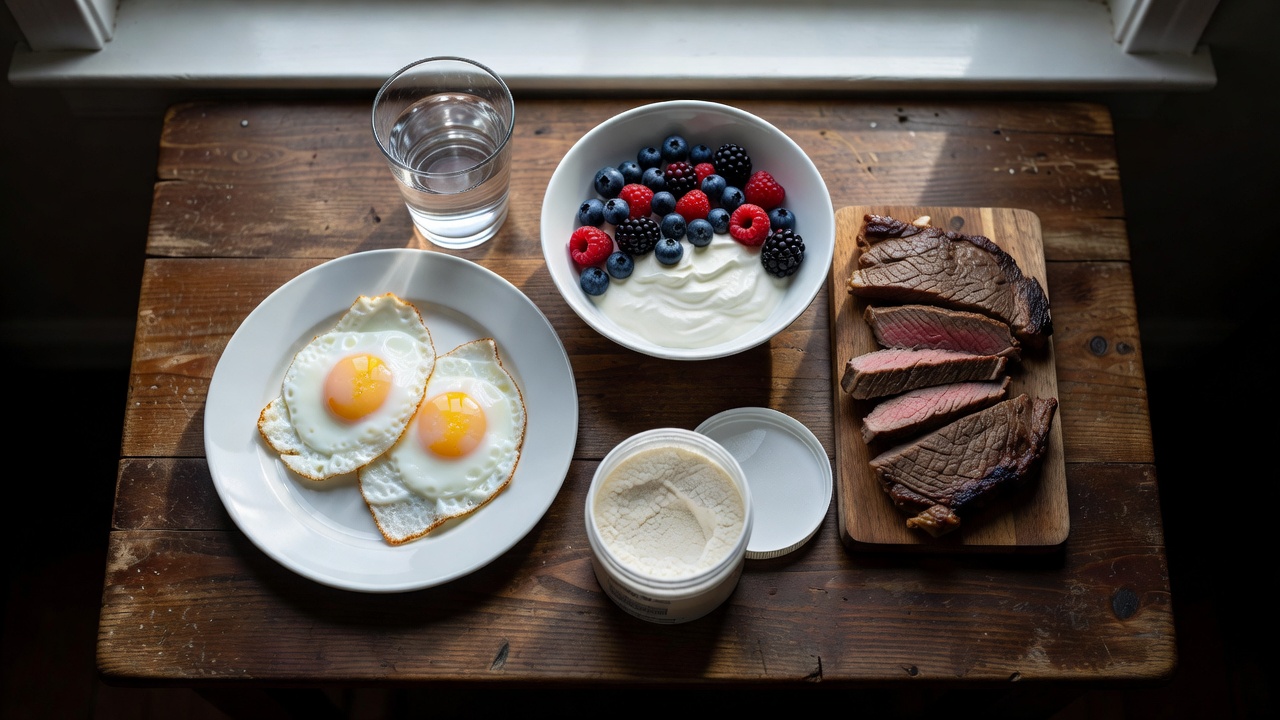
Protein got loud this week on two numbers at once: the grocery price and the gram target. Eggs and whey jumped, and the same feeds still told men over 40 they need more protein, not less. The default here is simple: keep the target, cheapen the source, put 30–40 g on the plate at each meal, and lift. Do not drop to the old RDA because the bill stung.
Not medical advice
This is a practical eating default for men over 40, not a prescription, lab protocol, or kidney plan. If you have kidney disease, gout, or a clinician already managing your diet, run the numbers past them.
What X is actually arguing
The loudest post of the week was not a hypertrophy study. It was a cost sheet. Eggs at 9–10₹ a piece (about a 40% hike), whey around 4200₹ per kilo, high-protein paneer at 180₹ — and a vegetarian 100 g protein day priced at 10–12k₹ a month before gym or coaching. The punchline: pay for health before the next EMI. Replies split immediately. One camp said 50 g is “enough” and the 100–150 g crowd is selling apps. The other camp said that 50 g is government rationing, not an optimal life.[1]
The price complaint is not only India. People posted whey tubs $50 above what they used to pay, and one account claimed a jump from $120 in April to $250 now. Plant protein was up too. A neurologist tied a 40% egg-price rise to ethanol blending in fuel and warned it would worsen already-low protein intake and sarcopenia. That is the first fight: protein as a line item that just got more expensive, at the exact moment the timeline is telling you to eat more of it.[2]
The second fight is the target. Fitness accounts still chant 1 g per pound of bodyweight (or goal weight), 40 g or more per meal, protein at breakfast. A 40s post this week put it in one line: lift, 1 g per pound, 8k steps, sleep. Coaches told men they are under-eating protein without noticing, then wondering why they are hungry and why muscle is harder to keep. That is the “protein went up” version that is not about rupees or dollars. The number people are using went up relative to the RDA you grew up with.[3]
Researchers on the same timeline are not chanting 1 g/lb. Stuart Phillips spent the week repeating the range that has not moved: 1.2–1.6 g/kg/day, 25–40 g per meal. Going from 25 g to 100 g in one sitting did not buy a matching jump in muscle protein synthesis. Past about 1.6 g/kg, extra protein is more work for no extra lean mass over months. A dietitian made the same point from the other side: new data that large doses still “work” does not mean the floor disappeared. You still need repeated 25–35+ g feedings with enough leucine. So the camps are: RDA (~0.8 g/kg), evidence range (1.2–1.6 g/kg), and bro-math (1 g/lb). They are not the same diet.[4]
The third fight is anabolic resistance versus the barbell. Several posts said the same 25 g that built muscle at 25 triggers a weaker response after 40, so you need more protein per meal. A counter-post cited a meta-analysis: resistance training erases most of that age-related blunting. Stimulus may matter more than chasing a bigger shake. That tension matters because it decides whether you spend another $50 on powder or just show up for two hard sessions.[5]
Last: powder versus food versus BCAAs. One owner of a supplement company told people to walk, cut alcohol, sleep, eat real protein, and skip the BCAA/mitochondria stack. A review from Brad Schoenfeld landed the same week: if total protein is ~1.6–1.8 g/kg with a full set of essential amino acids, extra BCAAs do not grow more muscle. Whey is still the cheapest gram for some men. For others it is now the item they dropped.[6]
Why this lands after 40
Muscle protein synthesis gets pickier. The leucine “on” switch still works, but older muscle needs a clearer signal — enough essential amino acids in one sitting, not 12 g sprinkled on toast. That is anabolic resistance in one sentence. You do not need a textbook. You need to stop treating a yogurt cup as a meal.
Sarcopenia is not a nursing-home word. Unplanned muscle loss after 40 is the default if you eat like a 28-year-old desk worker and train like a weekend warrior. Muscle is the organ that keeps you insulin-sensitive, keeps the weight from relocating to the belt, and keeps you able to pick up a suitcase in ten years. Cardio alone will shrink you. Protein without loading will not build much either.
The RDA (~0.8 g/kg) was built to prevent deficiency in sedentary adults, not to hold lean mass in a 45-year-old in a calorie deficit. A 90 kg man at RDA is looking at ~72 g. That is one decent chicken breast and a shake, and then cereal. Plenty of men in this age band are already there and calling it “eating clean.”
Price pressure hits this group specifically. You are the one who finally started tracking protein, buying the tub, ordering the Greek yogurt. When eggs and whey gap up, the easy reaction is to go back to rice and “I’ll eat more chicken next month.” That is how a 40% egg hike becomes a 40% protein cut. The men who can least afford the muscle loss are the ones most likely to treat protein as optional when it gets expensive.
Distribution matters more than it did at 25 because you get fewer high-quality feedings if breakfast is coffee and lunch is a meeting. One 80 g dinner does not fully replace three 30–40 g meals. The ceiling per meal is higher than the old 20–25 g myth, but the floor did not vanish. You still want repeated hits.
Lifting changes the protein math. If you never load the muscle, extra grams are expensive urine. If you lift 2–3 times a week, the same 1.6 g/kg actually has somewhere to go. That is why the “just eat more protein” posts that skip the barbell are incomplete.
The default, in enough detail to actually do it
Pick one number and stop negotiating it every Sunday.
Target: 1.6 g of protein per kilogram of bodyweight. If you are clearly obese, use goal weight or a rough lean-mass estimate, not peak scale weight. Examples:
- 80 kg man → ~130 g/day
- 90 kg man → ~145 g/day
- 100 kg man → ~160 g/day
- 200 lb man (91 kg) → ~145 g, not 200 g unless you like spending money and chewing
1.2 g/kg is the floor if appetite or budget is wrecked. 1 g per pound is optional, not the default. You will not lose the next decade of muscle because you ate 145 g instead of 200.
Per meal: 30–40 g of actual protein, 3–4 times a day. That is the 25–40 g band the research accounts still defend, with a bias toward the high side after 40. Breakfast counts. A 12 g yogurt does not.
What 30–40 g looks like on a plate (cooked edible portions, round numbers):
- 5–6 large eggs (~30–36 g)
- 150 g cooked chicken breast (~45 g) — use 120 g for ~35 g
- 170 g 93% lean beef (~35–40 g)
- 1 can tuna in water (~30–40 g depending on can)
- 200 g 2% Greek yogurt (~20 g) plus 150 g cottage cheese (~18 g) → breakfast that actually hits
- 200 g paneer or firm tofu (~30–36 g) — pair with dal or eggs if you are vegetarian
- 1 scoop whey isolate (~25 g) plus milk or yogurt to land at 35 g
- 250 g low-fat cottage cheese (~28–32 g)
Build the day around four slots, not macros in an app you will abandon.
A default day for a ~90 kg man (~145 g):
- Breakfast (35–40 g): 3 eggs scrambled in a pan with 200 g cottage cheese, or 2 eggs + 250 ml milk + 1 scoop whey. Coffee after the plate, not instead of it.
- Lunch (35–45 g): 150 g chicken or a can of tuna, rice or potatoes, vegetables. If you eat out, order the chicken/fish first and eat that before the fries.
- Afternoon (25–35 g): Greek yogurt + whey, or leftover meat, or milk + a tin of sardines if you can stand them. This is the meal most men skip. It is also the cheapest place to use powder if food is inconvenient.
- Dinner (40 g): 170–200 g fish, beef, or chicken, vegetables, the starch you actually like.
That is four protein hits without a 200 g hero day. If you only eat three times, make each one 40 g and add a 25 g shake on training days.
Budget rules, because protein went up:
Price your protein per 30 g, not per package. Eggs are still usually the cheapest complete animal protein even after a hike. Whole chickens and thighs beat breasts. Canned fish beats fresh when the fresh case is a luxury item. Milk and Greek yogurt still print cheap grams in most Western stores. Dry lentils and soya stretch a meat meal; they are not the whole plan after 40 if you care about leucine per sitting.
Whey: only if the cost per 25 g is lower than chicken or eggs at your store, or if it is the only way you hit breakfast. Flip the tub. Under ~80 g protein per 100 g powder you are buying filler. If the tub doubled, do not “stay loyal.” Recalculate or drop it and buy chicken.
Vegetarian default that does not pretend 50 g is optimal: eggs + dairy + a pulse at two meals + whey or a yeast/soya product if you tolerate it. Hitting 130 g on plants alone without powder is a part-time job. Pay for the powder or eat the eggs.
Training pairing: two or three full-body or upper/lower sessions a week. Compounds: squat or leg press, hinge, press, row, carry. Protein without this is a satiety tool. With this, it is the recovery substrate. Walk on the other days. Do not add a BCAA product on top of the meals above.
Deficit: if you are cutting, do not cut protein. Cut starch, booze, and liquid calories. Protein stays pinned. That is how you lose fat without donating the muscle you are trying to keep.
Logging, one week only: three days of weighing the protein foods, not the broccoli. Most men over 40 who “eat a lot of protein” are at 80–90 g. See the number. Then add the missing 30 g meal. Stop after a week of weighing; keep the pattern.
What people get wrong
Treating the RDA as a goal. 50–70 g prevents a deficiency diagnosis. It does not protect a 48-year-old in a cut. The “you only need 50 g” replies under the cost post are the trap.[1]
Jumping to 1 g per pound because Twitter said so, then burning out on chicken and a $250 tub. 1.6 g/kg already sits above what most of you eat. Fill that gap before you play bodybuilder math.
Putting all the protein at 9 p.m. One large dinner is better than none. It is not the same as 35 g at breakfast, lunch, and dinner. The floor per meal still exists.
Dropping protein when whey got expensive, instead of switching source. Eggs, milk, chicken, canned fish, and cottage cheese still exist. Powder is a convenience layer, not the food group.
Buying BCAAs, “mitochondrial compounds,” and extra leucine caps while breakfast is still toast. If total protein is adequate, isolated BCAAs are a tax. Spend it on meat or a better tub.[7]
Calling a plant-heavy day “high protein” because there are beans on the plate. After 40 you care about grams of protein and leucine in the sitting, not vibes. Pair the dal with dairy or eggs or a scoop.
Using protein as a license to skip lifting. Anabolic resistance is real; so is the finding that training closes a lot of that gap. The expensive diet without the session is the wrong trade.[8]
This week
- Weigh or log protein for three days. Write the daily total. No fixing yet. Most of you are lower than you think.
- Add one 30–40 g protein feeding you currently skip — almost always breakfast. Eggs, cottage cheese, or a shake. Same time every day.
- At your usual store, price 30 g of protein from eggs, chicken, Greek yogurt, canned tuna, and whey. Buy the cheapest two complete sources. Recalculate whey if the tub jumped.
- Pin the week to 1.6 g/kg (or 1.2 g/kg if the jump from current intake is huge). Do not start a 200 g challenge.
- Lift twice in the next seven days. Full body or upper/lower. Eat a 30–40 g meal within a few hours of the session. Do not add a new supplement.
- If you drink, cut the weeknight pours. Alcohol is the silent protein cut — calories without the muscle signal, plus worse sleep. Protein stays; booze moves.
Read next
Back to Trending on X.