Sleep, bloodwork, mitochondria
Archived — September 8, 2026
Snapshot of Trending on X that day. Current · All snapshots
Updated September 8, 2026. Trending in Health on X.
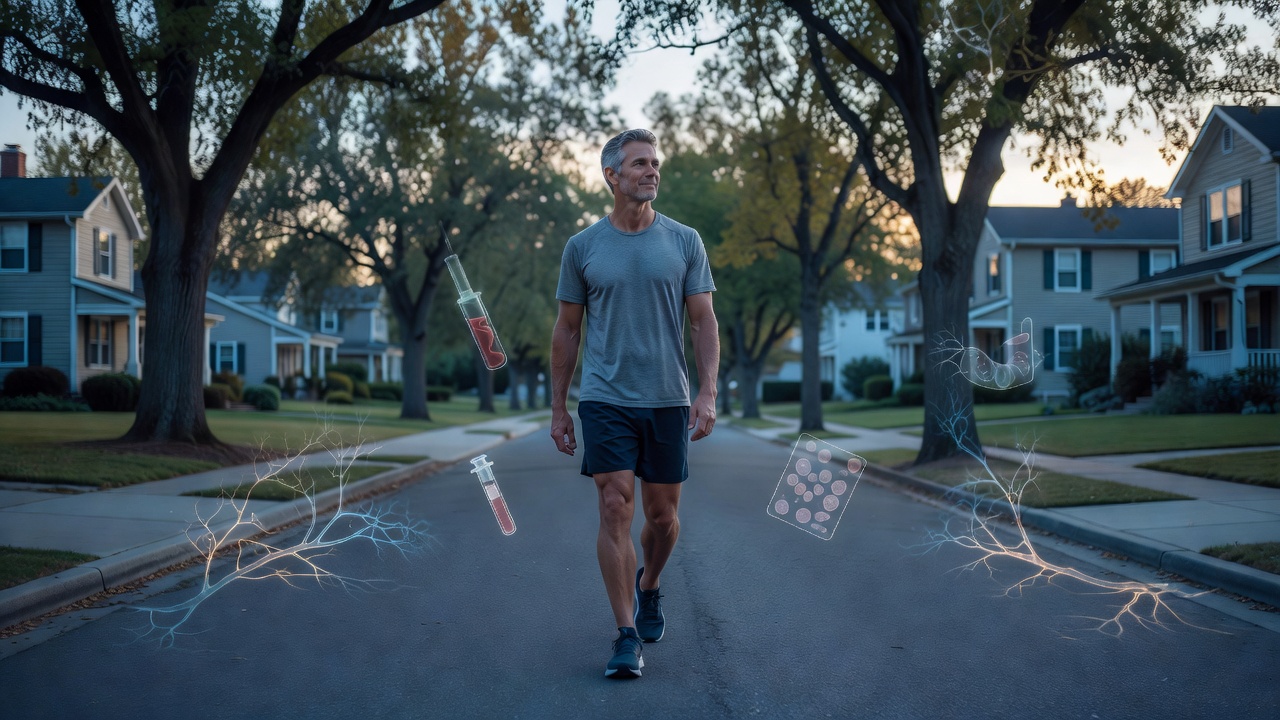
Huberman dropped a two-hour mitochondria episode and the timeline immediately split: one camp filled carts with CoQ10, NAD precursors, red panels, and “mito peptides,” the other said your energy factories fail because the night is wrecked, the labs were never drawn, and you never ask the tissue to work. This article takes the second camp. Sleep first, a real panel second, then train the organelle with walking, zone 2, and strength. Bottles come last, if at all.[1]
Not medical advice
This is a habit default for men over 40, not a diagnosis, lab interpretation, or clinic protocol. If you snore, wake unrefreshed, or have a known condition, talk to a doctor. Do not start peptides or prescriptions off a thread.
What X is actually arguing
The loudest object this week is mitochondria as the missing organ. Tired after 40 is framed as cellular power-plant decay, not “getting older.” Stirling Cooper’s thread put it in bedroom language: afternoon crashes, brain fog after meals, slow gym recovery, loss of morning erections. The prescribed rebuild was zone 2, cold, CoQ10, locked sleep timing, morning sun, then NAD. That is the product-shaped version of the fight.[2]
The science-shaped version is Huberman with biochemist Jared Rutter: mitochondria do far more than mint ATP. They allocate fuel, set cell identity, handle lactate, and throw off ROS when energy is in excess. The episode’s selling point on X was that it weeds out a lot of the metabolism nonsense in the same feeds pushing stacks. Nobody left that podcast with a shopping list. They left with “this organelle is a control system, not a battery you charge with a capsule.”[1]
A third camp, quieter and more useful, is foundation-first. Val Zudans: mitochondrial function starts with fuel, circadian entrainment, and strength hormesis — all free. Maybe CoQ10 or similar after the vest is on. Culture keeps hunting the silver bullet. Same week, the melatonin posts reframed sleep itself: pineal melatonin in blood is the circadian signal; most melatonin is made and spent inside mitochondria as a local antioxidant, with near-infrared in daylight as a trigger LEDs do not provide. Evening overhead blue light is not just “bad sleep hygiene.” It tells the clock it is morning, suppresses the pineal pulse, and cuts the night window when old mitochondria get recycled.[3]
Labs are the other pole. Men are posting full panels in public: ApoB, triglycerides, hs-CRP, fasting insulin, liver enzymes, free T3, total T. One widely circulated draw this week had excellent lipids and inflammation and a total T of 508 — “in range,” not a trophy. The argument is not that 508 is a crisis. It is that most men over 40 have never seen the page, and “normal” is a sick-person cutoff. Parallel thread: sleep apnea and low T travel together. Eight hours in bed that feel like four is not a mitochondria deficiency until you have ruled out the airway.[4]
The tension to name: stacks versus contrast (dark night, bright morning, real work). Resting labs versus “what breaks under load.” Melatonin as a gummy versus melatonin as a mitochondrial defense system. Feeling tired versus measuring the boring markers that actually explain tired.
Why this lands after 40
Testosterone is not a vibe. The first committed step in making it happens when cholesterol crosses the outer mitochondrial membrane. If sleep is short or mistimed, that factory loses both the overnight rise and the power supply. Most of the day’s T production is sleep-linked. A 2011 JAMA finding recirculated this week: one week of 5-hour nights dropped daytime testosterone 10 to 15 percent. It takes roughly three hours of unbroken sleep to reach the peak. Six-hour nights are not a personality. They are a hormone cut.[5]
CoQ10, the mobile electron carrier between complexes I/II and III, declines in heart tissue by more than 30 percent by age 40 and about 50 percent by 80. That is not an internet factoid invented this week; it is why CoQ10 threads exploded after the Huberman episode. Statins share the mevalonate pathway that makes both cholesterol and CoQ10, which is a clinician conversation, not a cart. The point for this page: electron flow gets less forgiving with age. You feel it as “I slept, I still have nothing.”[6]
Sleep itself fragments after 40. You doze, you wake at 3, you bargain with the ceiling. Low T and bad sleep feed each other. A tired man looks like a low-T man, which is why the blood draw comes after you stop lying about bedtime. Apnea is more common, so is extra body fat converting T toward estrogen, so is insulin resistance. You cannot out-discipline a deficiency or an airway. Vitamin D, B12, ferritin, thyroid, glucose — these show up as fog and “no drive” while the CBC looks fine.[7]
Mitophagy — recycling worn mitochondria — is a night job. Flatten the dark, flood the bedroom with LED, and you keep damaged organelles in circulation. Morning outdoor light, including overcast and shade, still carries infrared. Indoor LEDs do not. That is the free mitochondrial input the timeline keeps trying to replace with a panel on a stand.[8]
The default, in enough detail to actually do it
Do this in order. Do not skip to a stack.
1. Lock the night for seven days before you interpret anything.
Pick a bedtime and a wake time 7.5–8.5 hours apart. Example that fits most jobs: 10:30 p.m. in bed, 6:30 a.m. up. Same window ±30 minutes on weekends. Shifting two hours later is treated on X as an ATP hit; treat consistency as the intervention, not “more hours of scrolling in the dark.” Room: fully dark, cool (about 60–67°F), phone charging in another room. No overhead LEDs after sunset — lamps, not ceiling. Caffeine last call 2:00 p.m. Last large meal 2–3 hours before bed if reflux or 3 a.m. wake is your pattern. Alcohol off on weeknights for this block. It is a sleep tax and a mito tax.[9]
Morning: 10–20 minutes outdoors within an hour of waking, no sunglasses if your eyes and skin can take it. Overcast still counts. This is circadian and infrared, not a wellness walk. If you snore, gasp, get morning headaches, or your partner says you stop breathing, that is a sleep-study conversation with a doctor, not a CoQ10 problem. Home studies exist. Use them.[10]
2. Draw blood on a clean week.
Book a morning, fasted draw after two or three decent nights. Not after a red-eye, not at 4 p.m., not during a 5-hour-night week. Ask for more than a CBC and a total T:
- Total testosterone, free T, SHBG, estradiol
- Fasting glucose and fasting insulin (HbA1c if you can only get one extra)
- TSH, free T3, free T4
- Ferritin plus CBC
- Vitamin D, B12
- ApoB if available; otherwise a full lipid panel with triglycerides
- hs-CRP, ALT, AST
- Homocysteine and uric acid if the panel allows
You are not chasing Instagram-optimal. You are finding the boring leaks: iron, thyroid, glucose, apnea, vitamin D. A total T of 500 with wrecked sleep is not a diagnosis of “need a clinic.” Retest after the sleep block if the first draw was garbage conditions. Ninety-day cadence is what the men posting panels actually do. One draw is a snapshot. Two is a trend.[11]
3. Train the organelle with demand.
Mitochondria adapt to work you repeat. Endurance work sends AMPK / PGC-1α style “build more capacity” signals. Strength sends hormesis and keeps the dashboards that actually matter: lean mass, grip, aerobic capacity.
- Zone 2: 2–3 hours per week. Conversational pace — you can speak in sentences. Easy bike, brisk hills, easy jog, row. Split as 3×40 min or 2×50 plus a long walk. This is the biogenesis default, not HIIT every day.
- Strength: 2–3 sessions. Compounds: squat or leg press, hinge (RDL or trap-bar), press, row, carry. Sets of 5–8 on the big lifts, 2–4 work sets, leave 1–2 reps in the tank. Add a little load or a rep each week. Grip and a hard carry at the end.
- Walking: daily. 45–60 minutes or 7–10k steps. Not optional “cardio.” It is the recovery and glucose tool that lets the night work.
Do not add a fourth hard session to “boost mitochondria.” After 40, extra intensity without sleep is how you stall.
4. Fuel like an adult, not a protocol.
Protein 1.6–2.2 g per kg bodyweight. Three meals. Example day at ~90 kg:
- Breakfast after light: 4 eggs, 6 oz leftover steak or Greek yogurt, fruit.
- Lunch: 8 oz chicken or beef, rice or potatoes, vegetables, olive oil.
- Dinner: salmon or beef, potatoes, salad. Done 2–3 hours before bed.
Keep seed-oil deep-fried sludge and late sugar out of the sleep block. You do not need a keto religion. You need glucose that does not spike and crash, and enough carbs around training that zone 2 does not turn into a cortisol festival. If you are carrying a spare tire, a modest deficit plus the training above moves T more than another supplement SKU, because fat tissue aromatizes. That is this week’s other loud point: do not blame the testes first.[12]
5. What is not in the default.
No peptide stack. No “research chemical” MOTS-c. No methylene blue protocol. No NAD cart until the above has been boring for a month. Magnesium from food (meat, greens, pumpkin seeds); if you already use magnesium glycinate at night, that is a common X default, not a requirement. CoQ10 is the electron-shuttle story of the week — especially if a clinician has you on a statin — not a first move. Labs before labels.[13]
What people get wrong
- Buying NAD, red light, or peptides on 5.5-hour nights with no panel. You are putting premium gas in a car with no tires.
- One afternoon testosterone draw after a wrecked week, then treating that number as a life sentence. Morning, fasted, after sleep.
- Treating melatonin as a sleeping pill while blasting overhead LEDs until midnight. The blood rise is the clock. The mitochondrial pool wants darkness plus daytime infrared.
- Calling eight hours in bed “fine” when you snore. Apnea plus low T is a pair. Stacks do not open an airway.
- Reading “normal” as optimized. Reference ranges catch disease. They do not certify energy.
- Megadose antioxidants to “protect mitochondria” while skipping the work that makes them. ROS is also a signal. Throughput and demand beat muting the alarm.
- Cold plunges and gadgets before zone 2, bedtime, and a walk. Hormesis on top of a broken night is just more stress.
This week
- Set tonight’s bedtime and keep it seven nights. Charger leaves the bedroom. Caffeine dies at 2 p.m.
- Ten to twenty minutes outdoors every morning, including cloud cover.
- Book a morning fasted draw for next week. Write the marker list above on the lab order or portal.
- Two zone-2 sessions (30–45 minutes, conversational) and one strength session (compounds, 5–8 reps). Walk the other days.
- If you snore or wake unrefreshed, ask the person who sleeps near you, then ask a doctor about a sleep study.
- No new mito products this week. Run the free stack first. Reassess after the labs come back.
Read next
Back to Trending on X.