Eat the protein
Archived — September 9, 2026
Snapshot of Trending on X that day. Current · All snapshots
Updated September 9, 2026. Trending in Nutrition on X.
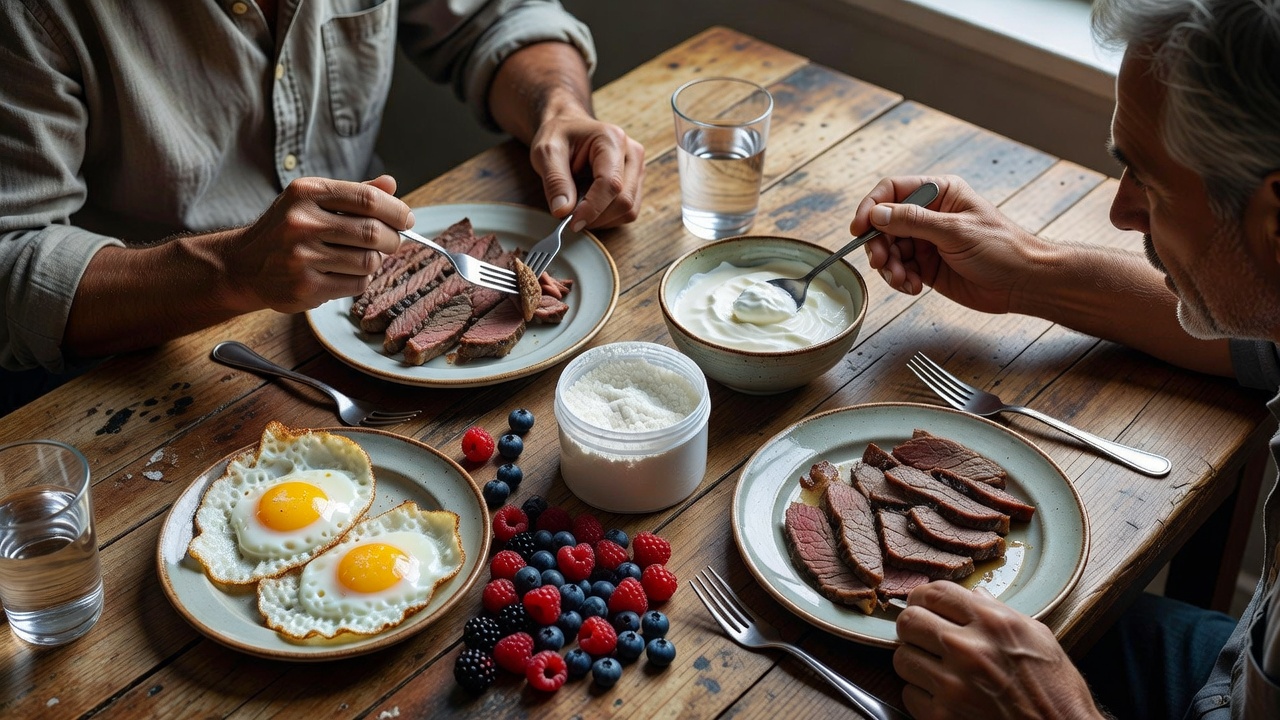
X this week is not arguing about superfoods. It is arguing that men over 40 are still eating like they are 28 — coffee until noon, a carb-heavy lunch, one decent dinner — while muscle leaves at 3 to 8 percent a decade. The loud posts are gram counts, breakfast plates, and leucine, not vibes. The default this article argues is blunt: hit a real daily target, in doses that actually register, starting in the morning.
Not medical advice
This is a food default for generally healthy men, not a diagnosis or a clinic protocol. If you have kidney disease, a prescribed diet, or unexplained weight loss, that is a doctor conversation, not an X thread.
What X is actually arguing
Two number systems are colliding, and most men are using the wrong one. One camp still quotes the old RDA: about 0.8 g per kilogram, which for a 180-pound man is roughly 65 grams a day. That number was built as a minimum to avoid deficiency in sedentary adults, not as a muscle-preservation target. The other camp — the one actually getting traction with men over 40 this week — is 0.8 to 1.2 grams per pound of bodyweight, or about 140 to 210 grams for a 175-pound man. Coaches keep repeating the same line: you are not eating enough protein, and as you age you get worse at using what you do eat, so you need more, not less.[1]
The second fight is distribution versus the hero dinner. A cluster of posts this week said the failure mode is not always a low daily total. It is 15 grams at breakfast, 20 at lunch, and 50 at 8pm. Under 40, scattered protein still moved the needle. After 40, the claim is a per-meal threshold: roughly 30 to 40 grams in one sitting to trigger muscle protein synthesis. Three meals of 20 grams and three meals of 35 grams can be the same calories and a completely different signal.[2]
The third fight is leucine and food quality, not “protein is protein.” Aging muscle is described as anabolic resistant: the same meal that used to flip the build switch now needs a bigger key. Leucine is that key. Eggs, dairy, meat, fish, whey, and soy show up because they deliver it. A bowl of oats with a splash of milk does not. Several posts framed this as independence at 80, not a beach photo.[3]
A quieter but useful split: protein as a blood-sugar and satiety tool, not only a hypertrophy tool. Eat protein (and fiber) first, then the starch. Same plate, smaller spike, fewer 3pm raids. Extreme cutting without protein is getting called out as the thing that backfires harder after 40 — undereating, higher cortisol, more muscle lost in the deficit. A small pilot in men over 55 with obesity and prediabetes made the rounds: 1.4 versus 0.8 g/kg, both in a deficit with exercise; the higher-protein group lost more weight and less fat-free mass. Pilot, men only, not a commandment — but it matches what the feed is yelling.[4]
What went loud in the how-to lane were boring lists: eggs, Greek yogurt, chicken, whey, milk, paneer, cottage cheese, adding to 140 grams. Those posts spread because they are copyable. The argument is not gourmet. It is arithmetic.[5]
Why this lands after 40
Muscle is not a vanity organ. It is the tissue that burns glucose, keeps you off the floor, and decides whether a calorie deficit makes you lean or just smaller and weaker. After 30 you lose on the order of 3 to 8 percent of muscle per decade if you do nothing. After 40 the slope is obvious in the gym and on the stairs. You cannot rebuild that on 50 to 60 grams a day.[6]
Anabolic resistance is the mechanism, not a slogan. Older muscle still responds to protein and lifting. It just needs a clearer dose. A 20-gram meal that worked at 25 often does not clear the leucine threshold at 45. That is why “I eat protein” can still fail: yogurt on the oats, a few slices of turkey, a dinner steak, and the daily log looks respectable while three of four meals never switched synthesis on. Overnight you are already in a fast. Coffee until 11am extends it. Then you wonder why the pantry owns you at 4pm and recovery feels like wet cardboard.[7]
A deficit without protein is a muscle donation. The scale can drop while the engine shrinks. Less muscle means a slower daily burn, worse glucose handling, and joints that complain on ordinary walks. The men chasing fat loss with appetite-crushing tricks still have to land protein or they come off looking deflated. Protein first is also the cheapest satiety hack on the table: it fills you, it is hard to binge, and it leaves less room for the liquid calories and snacks that actually drive the surplus.
You do not get a free pass because you “eat clean.” You get a pass when the grams hit, repeatedly, next to a lifting stimulus and enough sleep that the repair actually happens.
The default, in enough detail to actually do it
Default target: 1 gram of protein per pound of goal bodyweight, every day. If you weigh 205 and your honest goal is 185, eat 185 grams, not 205. If you are 170 and lean enough, eat 170. If 1 g/lb feels like a cliff, start at 1.6 g per kilogram (about 0.75 g/lb) this week and climb. Do not start at the RDA and hope.
Split it. 30 to 45 grams per meal, 3 to 4 times a day. Do not save it for dinner. A working schedule for a man who wakes at 6:30:
- 7:00–8:00 — breakfast, 35–45 g
- 12:00–1:00 — lunch, 40–50 g
- 3:30–4:30 — optional snack, 25–35 g (use this if lunch was light)
- 6:30–8:00 — dinner, 40–50 g
Lock breakfast. Target 35–40 grams before 9am. Coffee is not a meal. Three eggs plus a cup of egg whites, or 2 cups of Greek yogurt with a scoop of whey, or eggs plus cottage cheese. That one move stops the 4pm raid for a lot of men.[8]
Build the plate around the protein, then add starch and plants. Eat the protein first. Real food first, powder second. A shake is a gap-filler, not a personality.
What 30–45 grams actually looks like (cooked weights, ballpark):
- 4 large eggs — ~24 g. Add 150–200 g Greek yogurt (~15–20 g) or a cup of cottage cheese (~25 g) and you are there.
- 150 g cooked chicken breast — ~45 g
- 170 g (6 oz) extra-lean ground beef — ~40 g
- 170 g salmon or white fish — ~35–40 g
- 1 can tuna, drained — ~25–30 g. Add cottage cheese or Greek yogurt.
- 100 g paneer or firm tofu — ~18–20 g. Stack it; do not pretend it is a full meal alone.
- 1 scoop whey in water or milk — ~20–25 g, plus the milk (~8 g per 250 ml)
A 180-gram day that does not require a chef:
- Breakfast: 3 eggs scrambled, 200 g 2% Greek yogurt, salt. ~40–45 g.
- Lunch: 180 g cooked chicken thighs, rice or potatoes, frozen broccoli. ~45–50 g.
- Snack: 1 cup cottage cheese or 1 scoop whey plus a banana if you trained. ~25–30 g.
- Dinner: 200 g 93/7 ground beef or a sirloin, potatoes, green beans. ~45–50 g.
If you train after work, keep dinner the same size. Do not “earn” a cheat that wipes the protein and dumps alcohol on the recovery.
Grocery default, one trip: two dozen eggs, two tubs Greek yogurt, two tubs cottage cheese, 3–4 lb chicken thighs or breast, 2 lb ground beef, a couple of fish fillets or cans of tuna, a bag of frozen veg, potatoes or rice, whey if breakfast is chaotic. That is the week. You are not hunting exotic powders.
How to count without an app forever: for one week, weigh the protein portion. Learn that 100 g of chicken is about 30 g of protein, not 100 g of protein. After that, eyeball from a palm-and-a-half of meat plus the dairy. If lunch was a sandwich with two slices of turkey, you did not hit 40 grams. Fix dinner and the snack that day; do not “start Monday.”
Lift. Protein without a load is expensive urine plus slightly better satiety. Two to four hard strength sessions a week is enough of a stimulus. Walk. Sleep. None of that replaces the grams.
Kidney fear: high protein in healthy kidneys is not the villain this feed thinks it is. Known kidney disease is a different sentence. Do not self-prescribe a 220-gram diet on top of a medical protein restriction.
What people get wrong
They treat the RDA as a goal. 0.8 g/kg is a floor for not getting deficient. It is not a muscle plan after 40. Fifty grams a day is a slow fade: less muscle, slower burn, louder cravings, joints that complain on easy walks.[9]
They think 100 g of chicken is 100 g of protein. It is roughly 30. The same error hits yogurt, tofu, and “I had a protein bar.” If you cannot name the main protein on the plate, it was a garnish.
They skip breakfast and dump 60 grams at 8pm. Synthesis is not a once-a-day switch. Empty mornings plus one steak still leave hours with nothing to build on.
They add a shake on top of the same pastry breakfast. Most of the time it is a swap, not an addition. Drop the cereal and the juice. Put eggs or yogurt in that slot. Extra powder on a junk day is how you get 250 extra calories and still miss the leucine dose at two meals.[10]
They confuse creatine, collagen, or “amino formula” with protein. Creatine can help the muscle cell work. It does not supply the amino acids that become tissue. Collagen in coffee is not a 40-gram meal. If the tub is your only plan, read the label and still eat food.
They cut hard first. Extreme diets after 40 raise the odds you donate muscle to the deficit. Eat enough, eat protein first, then run a small deficit if fat loss is the job. The scale lying to you for two weeks of starvation is not a win.
This week
- Pick the number: goal bodyweight in pounds = daily protein grams. Write it on a note in the kitchen.
- Weigh protein at four meals for seven days. Hit 30–45 g each time. If one meal misses, do not “average it tomorrow” — add a yogurt, tuna, or shake the same day.
- Fix breakfast before you fix anything else. 35–40 g before 9am, no debate, including travel days. Eggs, Greek yogurt, cottage cheese, or a shake if you are in a car.
- Shop once for the default list above. Cook two proteins on Sunday (chicken + ground beef or fish) so lunch is assembly, not a sandwich accident.
- Lift at least twice in the next seven days. Protein without a load is half a plan.
- Drop one liquid calorie habit that crowds out food — the afternoon beer, the sweet coffee — and put those calories into meat or dairy instead.
Read next
Back to Trending on X.