30–40 g per sitting
Archived — September 10, 2026
Snapshot of Trending on X that day. Current · All snapshots
Updated September 10, 2026. Trending in Nutrition on X.
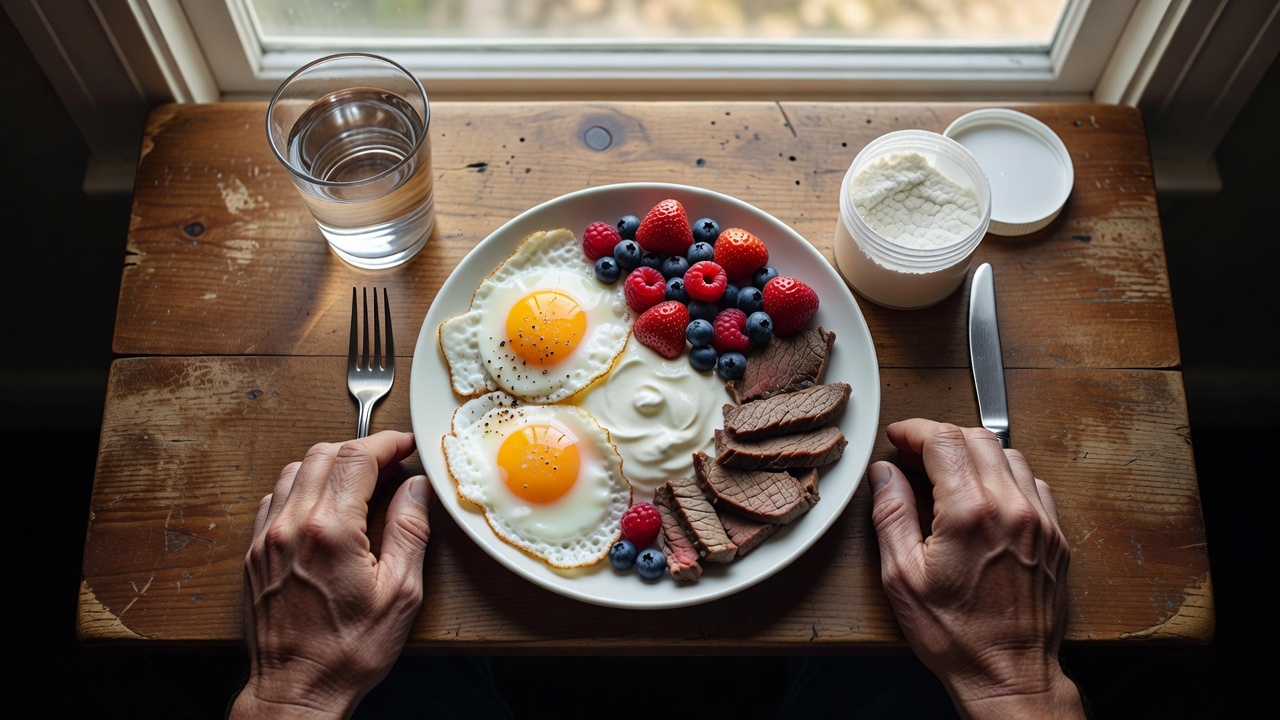
This week’s nutrition fight on X is not “eat more protein.” It is whether a man over 40 can graze 15–20 g hits, skip breakfast, then dump 80 g at dinner and still get a muscle signal. The loud default from 40+ coaches is blunt: 30–40 g of quality protein in one sitting, three to four times. Same food. Same calories. Completely different result.[1]
Not medical advice
Protein numbers here are a practical default for generally healthy men, not a diagnosis or a clinic protocol. If you have kidney disease, a GI condition, or a doctor’s restriction, that overrides anything on this page.
What X is actually arguing
Two camps are talking past each other.
Camp one: daily total is the only number that matters. Hit 0.8–1 g per pound of goal bodyweight and stop obsessing over meals. A shake at night “makes up” a toast breakfast. This is the younger-lifter habit that a lot of men over 40 still run.[2]
Camp two: after 40 the meal is the unit, not the day. Muscle protein synthesis is a pulse. Each sitting has to clear a leucine bar — roughly 2.5–3 g leucine, which in practice is 30–40 g of animal or whey protein — or the pulse never starts. Three meals of 20 g is not “60 g of protein.” It is three missed signals. Three meals of 35 g is three hits.[3]
A third group is still running OMAD or hard fasting. One hero dinner after empty mornings. The pushback this week is that MPS is not a once-a-day switch. Hours with no protein are hours with nothing to build on, even if the dinner is huge.[4]
The practical middle — and the one this page takes — is boring: target about 0.8–1 g per pound of goal bodyweight, split across 3–4 sittings that each clear 30–40 g. Not one hero shake. Not eight 12 g “protein snacks.” Real food first, a scoop if a meal is short.[4]
The food posts this week are the same plate on repeat: eggs and cottage cheese at breakfast, chicken or beef at lunch, steak or ground beef at dinner, potatoes or rice for fuel, a frozen vegetable so the plate is not beige. The caption is always some version of: you lose 3–8% of muscle a decade after 30, and you cannot rebuild it on 60 g a day.[5]
Why this lands after 40
You are not 28. The same 25 g chicken wrap that “worked” in your thirties often does not clear the bar now.
Anabolic resistance is the mechanism. Aging muscle needs a bigger leucine key to turn MPS on. Twenty grams of mixed food that used to register now barely does. That is why “30 g per meal after 40” keeps showing up as a slogan — it is a crude proxy for “enough leucine in one bolus.”[6]
MPS also has a refractory period. You want a rapid bolus, then a gap, then another bolus. Sipping protein all afternoon, or running a “whey drip,” fights that. The pulse needs a peak, then a break, then another peak. That is why 3–4 distinct sittings beat grazing.[7]
The other constraint is behavior, not biochemistry. Men over 40 skip breakfast, drink coffee until 1 p.m., eat a sandwich that is mostly bread, then eat a normal dinner and call it 80–90 g for the day. Appetite is lower. Work lunches are carbs. Collagen coffee and bone broth get counted as protein even though collagen is essentially leucine-free. Twenty grams of collagen is not a sitting. It is close to nothing for muscle.[8]
Meanwhile the loss is already running. Roughly 1% muscle per year if you do nothing, 3–8% per decade after 30 in the worse estimates floating this week. Metabolic rate drops with the muscle. Afternoon cravings go up. Joints feel worse on walks because there is less tissue around them. Protein will not fix joints by itself. It will stop you from eating 50 g a day and wondering why the scale is “skinny-fat.”[9]
You also recover slower. A 40+ man who lifts without enough protein per meal is paying for the session twice: sore longer, adapting less. The training is not the bottleneck. The sitting is.
The default, in enough detail to actually do it
Default, not a personality:
- Per sitting: 30–40 g of quality protein. Quality here means eggs, dairy, meat, fish, whey — foods that actually carry leucine. If you are plant-heavy, you will need a larger plate or a leucine-dense add-on to hit the same bar. Do not pretend 30 g of random mixed plants is the same sitting.
- Sittings per day: 3, preferably 4. Breakfast, lunch, dinner, optional late snack if dinner is early.
- Daily total: 0.8–1.0 g per pound of goal bodyweight. A 180 lb goal is 145–180 g. A 200 lb goal is 160–200 g. That math only works if the sittings are real. Four 20 g meals is 80 g of disappointment.
- Spacing: 4–5 hours between boluses. Do not sip. Eat, stop, wait.
- Training: protein without a lift is just expensive urea. Two to three strength sessions a week is the minimum that makes this worth doing. Walk daily.
What 35 g actually looks like. Stop guessing. Weigh cooked food twice, then you can eyeball.
| Food | Amount | Protein |
|---|---|---|
| Chicken breast, cooked | 5 oz / 140 g | ~40 g |
| Chicken thighs, cooked | 6 oz / 170 g | ~35 g |
| 93/7 ground beef, cooked | 5 oz / 140 g | ~35 g |
| Sirloin, cooked | 6 oz / 170 g | ~45 g |
| Salmon, cooked | 6 oz / 170 g | ~35 g |
| Canned tuna, drained | 1 can (5 oz) | ~30 g |
| Sardines | 1 tin | ~20–22 g |
| Whole eggs | 4 large | ~24 g |
| Egg whites | 1 cup | ~26 g |
| Cottage cheese, 2% | 1 cup / 220 g | ~24–28 g |
| Greek yogurt, 0–2% | 1 cup / 225 g | ~20–22 g |
| Whey isolate | 1 scoop | ~24–27 g |
A sitting is usually one animal portion plus a dairy or whey add if the meat is small. Four eggs alone is not 30–40 g. Four eggs plus a cup of cottage cheese is.
Three repeatable plates. Repeat them. Do not menu-plan like a food blog.
- Breakfast (the one most men miss). 3 whole eggs + 1 cup egg whites scrambled, or 4 eggs + ¾–1 cup cottage cheese. Salt, pepper, hot sauce. Fruit or potatoes if you train in the morning. That is 35–50 g. Coffee does not count. Toast with peanut butter does not count. If you cannot cook, 1.5 scoops whey in milk plus 200 g Greek yogurt is a legal sitting. Protein-first breakfast is the habit that shows up every time someone posts “high-T mornings.” Use it for the grams, not the brand.[10]
- Lunch. 6–8 oz cooked chicken thighs or a rotisserie breast quarter, rice or potatoes, a frozen vegetable. 40–50 g. Canned tuna + Greek yogurt + crackers is the desk version: two cans if one can is only 30 g and you eat the crackers.
- Dinner. 6–8 oz 93/7 beef, sirloin, or fish, potatoes, green vegetable. 40–55 g. This is the easy meal. Stop making it the only meal.
If you need a fourth sitting, it is 200 g Greek yogurt + 1 scoop whey, or cottage cheese + a tin of sardines — not a protein water and not a collagen latte.
A 180 lb man, four sittings, ~160 g:
- 07:30 — 4 eggs + 1 cup cottage cheese (~48 g)
- 12:30 — 5 oz cooked chicken + rice + broccoli (~40 g)
- 17:00 — 1 scoop whey if dinner will be late (~25 g) or skip if dinner is on time and bump dinner
- 19:00 — 6 oz sirloin + potatoes + green beans (~45 g)
That is already past 160 g without a “diet.” Carbs sit next to the protein for training fuel. Fat comes with the eggs and beef. You do not need a macro app after week one if the plates repeat.
Shopping list that survives a work week: two dozen eggs, two large tubs cottage cheese or Greek yogurt, a family pack of chicken thighs, 93/7 beef, one bag frozen broccoli, potatoes or rice, canned tuna or sardines, one bag of whey. Cook the chicken and beef on Sunday. Breakfast is 8 minutes. Lunch is a box.
If you train at 6 a.m.: eat the breakfast sitting after the session, not a banana. If you train at lunch, make lunch the bigger 40 g plate. Do not save all the protein for “post-workout magic.” The sitting after training matters. So do the other two.
If appetite is trash: liquid the first sitting (whey + milk + yogurt), solid the rest. Do not use low appetite as a reason to run 20 g meals. Blend it.
What people get wrong
- Counting the day, not the sitting. 120 g that is 15 g × 8 snacks is not 120 g of signal. Log protein per meal for a week. If two meals are under 30 g, those meals did not happen.[1]
- The empty morning, hero dinner. Fasting until 2 p.m. then eating a 70 g dinner still leaves the whole morning with no pulse. After 40 that is not “autophagy.” It is unpaid hours.[4]
- Calling 50–60 g a day “high protein.” That is maintenance for a sedentary small woman, not a 180 lb man trying to keep muscle. You cannot rebuild on 60 g. Stop using the RDA as a flex.[5]
- Collagen, bone broth, and protein water as a sitting. Collagen is leucine-poor. Most protein waters are 10–20 g and taste like vitamins. Neither is a 30–40 g sitting. Whey, meat, eggs, dairy. Then stop.[8]
- Toast, oatmeal, and “a little peanut butter” as breakfast. That is a carb meal with a protein rumor. Add the eggs or the yogurt first. Then, if you still want oats, put them next to 30 g, not instead of it.
- One scoop at 10 p.m. to “hit the number.” A 25 g shake at night does not retrofit a 12 g breakfast and a 18 g lunch. Fix the first two sittings. The night shake is a patch, not a plan. The fat-loss stack circulating this week is the same four habits: 30–40 g per meal, walk 30 minutes, lift 3×, sleep 7–8 hours. None of those is a 10 p.m. rescue shake.[11]
This week
- Write down protein per sitting for the next 3 days. Not the daily total. Breakfast, lunch, dinner. If a line is under 30 g, circle it.
- Fix breakfast first. Pick one: 4 eggs + cottage cheese, or yogurt + 1.5 scoops whey. Eat it every morning for 7 days. No debate.
- Cook one protein in bulk on day 1. Five pounds of chicken thighs or 93/7 beef. That is lunches. Stop deciding at 12:40 p.m.
- Build three plates you can name. Eggs plate. Chicken plate. Beef plate. Each already at 35 g+ before condiments. Repeat them. Variety is how men over 40 fall back to sandwiches.
- If a meal will miss 30 g, add, don’t postpone. Extra eggs, a can of tuna, a scoop. “I’ll make it up at dinner” is how this week’s discourse keeps losing.
- Lift twice in the next 7 days. Squats, hinges, pushes, pulls. Protein without a stimulus is just a grocery bill. Walk on the other days.
Read next
Back to Trending on X.