40 g protein per meal
Archived — September 18, 2026
Snapshot of Trending on X that day. Current · All snapshots
Updated September 18, 2026. Trending in Nutrition on X.
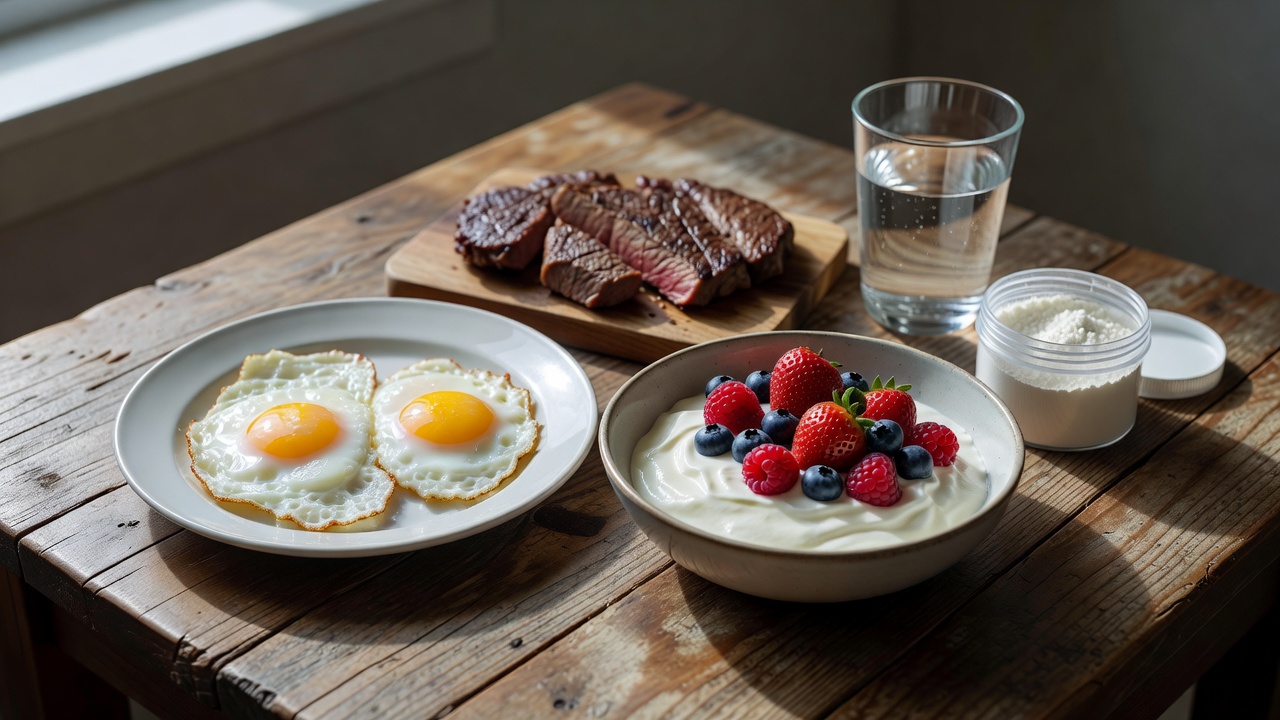
This week’s nutrition fight on X is not whether protein matters after 40. It is how much has to sit on the plate before the meal even counts. One camp still cites 25–30 g as the muscle-protein-synthesis trigger and a European sarcopenia range of 1.0–1.2 g per kilogram. The louder practical camp says anabolic resistance has moved the bar, breakfast is where men fail, and 40 g is the number that actually changes the day. This article takes 40 g per meal as the default.[1]
Not medical advice
This is a food default for generally healthy men over 40, not a diagnosis, a kidney protocol, or a substitute for a clinician who has your labs. If you have kidney disease, are under treatment, or have been told to restrict protein, get that cleared before you copy anyone’s plate.
What X is actually arguing
Three numbers are colliding, and people are treating them as if they are the same argument.
Camp one is the distribution camp. The post that actually moved this week — hundreds of likes, thousands of bookmarks — said the meal that built muscle at 25 barely registers at 50. Anabolic resistance means the same dose of protein triggers less muscle protein synthesis. Most adults over 50 are eating 60–70 g a day. The pattern that does the most damage is a carb breakfast and a protein-heavy dinner. Spread 25–30 g across meals and you at least stop missing the trigger twice a day. That is the moderate scientific line, and it is already more protein than most men eat.[1]
Camp two is the plate camp, and it is louder among coaches talking to working men. Forty to 50 g on every plate. One gram per pound of goal bodyweight, split across the meals you already eat. Breakfast is the failure point: coffee and toast at 7 a.m. is why the cupboard opens at 9 p.m. Front-load 40–50 g within an hour of waking and the last four hours of the day stop being a fight. Same daily total as a huge dinner. Completely different day.[2]
Camp three is the daily-total camp, arguing past the plate. Non-negotiable lists after 40 put protein at 0.7 g per pound of bodyweight. A US man 40–49 averages about 205 lb at roughly 30% body fat; protein for lean mass lands near 140 g, which is “not that hard with a little effort.” Hypertrophy ranges cited this week go 1.6–2.2 g per kilogram. The old RDA of 0.8 g per kilogram was set on young adults and does not account for aging digestion or resistance training. Those are different jobs. Do not mix them.[3]
A leftover 2009 claim still shows up: the body can only use ~20–40 g per meal for muscle synthesis, so 80 g at dinner is nearly the same as 40 g. That is the ceiling argument. The over-40 counter is the opposite: older muscle needs a larger dose, closer to 30–40 g of leucine-rich food, because 15 g at breakfast does not clear the threshold. Both can be true in a sloppy way. A giant dinner does not double the anabolic response. A tiny breakfast still fails. The fix is not one 80 g meal. It is three meals that actually hit.[4]
Quality is the side fight. Collagen inflates the nitrogen number on a label and contributes almost no leucine. Plant protein can work if the dose is matched: roughly 38–40 g of pea to equal the leucine in 25 g of whey. Three eggs are ~18 g. They are not a 40 g meal. If you count collagen, toast protein, and a yogurt lid, you will log 40 g and still miss the amino acids that turn the switch.[5]
Why this lands after 40
Muscle after 40 is less greedy. The same 20 g whey hit that lit you up at 25 does not clear the leucine threshold as reliably. You need a larger, higher-quality dose at each eating occasion, not a bigger weekly average dumped at 8 p.m. That is anabolic resistance in one sentence. Resistance training still amplifies the response. Protein without loading does half the job.[6]
The American eating pattern is built to miss this. Breakfast is caffeine and starch. Lunch is a sandwich that looks like protein and weighs out at 20 g. Dinner is where the steak happens, if it happens. Distribution research keeps saying even totals beat a late bolus. After 40, the missed breakfast is not a vibe problem. It is a missed synthesis window you do not get back at 9 p.m. with extra chicken.[7]
Satiety is the other mechanism, and it is why the 10 p.m. raid keeps getting blamed on willpower. Thirty to 40 g at the first meal suppresses hunger longer. Protein first, fiber next, carbs last, same calories, smaller glucose swing. For a man carrying extra fat, that is the practical reason 40 g wins even if you never think the word sarcopenia. You stay out of the cupboard. You keep the muscle that sets your resting burn. You stop dieting like a 25-year-old who can get away with toast.[8]
Body size matters more than influencer grams. A 70 kg textbook example needs ~84 g at sarcopenia minimums. That man is not the mean 40-year-old in the US. If you weigh 190–210 lb, three 25 g meals leave you in a chronic deficit that looks like “I’m just getting softer.” Forty grams per meal is how a heavier man hits a 140 g floor without turning dinner into a protein loading dock.[9]
The default, in enough detail to actually do it
Default: 40 g of actual protein at breakfast, lunch, and dinner. Optional 20–30 g snack if dinner is late or training sits between meals. Daily floor: 0.7 g per pound of current bodyweight, or of goal weight if you are carrying a lot of fat. For 200 lb, that is 140 g. Three 40 g meals plus a 20 g snack. If you lift 2–3 days a week and want to keep or build muscle, run closer to 0.8–1.0 g per pound. Do not start at 2 g per pound. Hit 40 g three times first.
Count cooked edible protein, not the weight of the meal. Lead the plate with it. Eat the protein, then the vegetables, then the starch. Same meal, better satiety.
What 40 g looks like, no spreadsheet required
Breakfast, pick one and repeat it:
- 4 whole eggs (24 g) plus 170 g (6 oz) plain Greek yogurt (17 g). About 41 g. Ten minutes.
- 3 eggs (18 g) plus 4 egg whites (14 g) plus 150 g Greek yogurt (15 g). About 47 g. The version coaches keep posting because it is fast.[10]
- 1 scoop whey (22–25 g) stirred into 1 cup 2% Greek yogurt (20 g). About 42–45 g. No pan.
- 1.5 cups low-fat cottage cheese (35–40 g) plus 2 eggs (12 g) if you want it as food, not a shake.
- 5 oz smoked salmon (28 g) plus ¾ cup cottage cheese (18 g) if you already eat that way.
Lunch:
- 6 oz cooked chicken breast. About 50 g. Five ounces is ~42 g. Weigh it once, then use the same cut.
- 1 can tuna in water (20–25 g) plus 1 cup cottage cheese (25 g). About 45 g. Desk lunch.
- 6 oz 93% ground beef. About 42 g. Bowl with broccoli and rice if you train that day.
- 2 chicken thighs, skin off after cooking, plus 150 g Greek yogurt on the side if the thighs undershoot.
Dinner:
- 7 oz sirloin or 6–7 oz salmon. Mid-30s to low-40s. Add ¾ cup Greek yogurt or a cup of cottage cheese if the fish is closer to 34 g.
- Rotisserie chicken: two breast halves, skin off. Usually 40–50 g. Buy two birds on Sunday.
- 6 oz pork loin plus a cup of skyr or Greek yogurt.
Snack, only if you need it to hit the daily floor:
- 1 cup cottage cheese (~25 g)
- 1 scoop whey in water (~24 g)
- 170 g Greek yogurt (~17–20 g) — not enough alone; pair it
Schedule
Meal 1 within 60 minutes of waking, or whenever you break the fast if you skip breakfast. The clock is less important than the dose. If your first bite is at noon, that bite is still 40–50 g, not a salad. Then every 4–5 hours. Do not save 80 g for 8 p.m. A protein-heavy dinner with a carbohydrate-heavy breakfast is the worst pattern for muscle, and it is the pattern most adults already follow.[11]
If you train after work, keep lunch at 40 g and put the extra 20 g in a shake after the session or as cottage cheese before dinner. Do not skip lunch protein because “I’ll eat after the gym.” That is how the evening becomes a raid.
Sunday 20-minute setup
Cook 3 lb chicken breast or thighs. Portion 5–6 oz cooked into 6 boxes. Buy a large tub of Greek yogurt, a large tub of cottage cheese, two dozen eggs, and two cans of tuna. That is a work week of 40 g lunches plus breakfast insurance. Frozen broccoli, one bag of rice if you train, fruit if you want it. You are not building a cookbook. You are removing the 11 a.m. decision.
Cheap sources that actually hit leucine
Eggs, milk, Greek yogurt, cottage cheese, canned tuna, sardines, chicken, 93% beef. If you use powder, whey is the easy leucine hit. Pea or soy works when you take the larger scoop — about 38–40 g plant protein to match 25 g whey — not when you treat 25 g pea like 25 g whey. Do not use collagen as your meal protein. It can sit in coffee. It does not replace the chicken.[12]
What not to change this week
Do not start a new diet. Do not cut carbs to zero unless you already eat that way. Do not add five supplements. Protein first, 40 g, three times. Walk after meals if you want a free blood-sugar assist. Lift 2–3 days. That is the stack. Everything else is noise until these meals exist.
What people get wrong
-
Calling three eggs breakfast. Three eggs are ~18 g. You still need another 20 g sitting next to them. The “high protein breakfast” that is two eggs and toast is a 15 g meal with good marketing. Fifteen grams does not clear the threshold after 40.[13]
-
Coffee and toast, then a heroic dinner. Same daily total as three 40 g meals, worse day. Hunger at 11, cupboard at 9, muscle that only gets a signal once. Front-load or at least split it.
-
Logging collagen, bone broth, and “protein” cereal as muscle food. Nitrogen on a label is not leucine. If the serving cannot put ~2.5–3 g leucine in you, it does not count toward the 40 g.
-
Believing extra grams in one sitting are wasted, so lunch stays small. The 20–40 g ceiling is about the MPS peak, not a reason to eat 18 g at noon. Older muscle wants a larger dose per meal. It does not want one 90 g steak at 9 p.m. as your only attempt.
-
Using the 0.8 g/kg RDA as if it were a training diet. That number came from young adults and “not deficient” studies. Healthy older-adult consensus already sits at 1.0–1.2 g/kg, and lifting men need more than “not deficient.” If you weigh 200 lb, 0.8 g/kg is a diet for a smaller person.
-
Thinking 40 g is expensive or requires a shake every hour. Eggs, canned fish, yogurt, and a rotisserie chicken cover most of the week. The hard part is weighing once and repeating, not finding exotic meat.
This week
- For the next three days, write down only breakfast protein in grams. No full tracker required. If it is under 30 g, that meal is the problem, not your willpower at 10 p.m.
- Pick one 40 g breakfast from the list above. Eat it every day for seven days. Same food. Boring on purpose.
- Weigh cooked chicken or beef once. Learn what 5–6 oz looks like on your plate. Use that pile at lunch for the rest of the week.
- Lead every meal with the protein. Vegetables second. Starch last. Do not change the menu, change the order.
- If dinner is after 8 p.m., add a 20–25 g afternoon snack so you are not asking one meal to do the whole day.
- Lift two or three sessions this week. Protein without a load still helps satiety. It does less for the muscle you are trying to keep.
Read next
Back to Trending on X.